Image
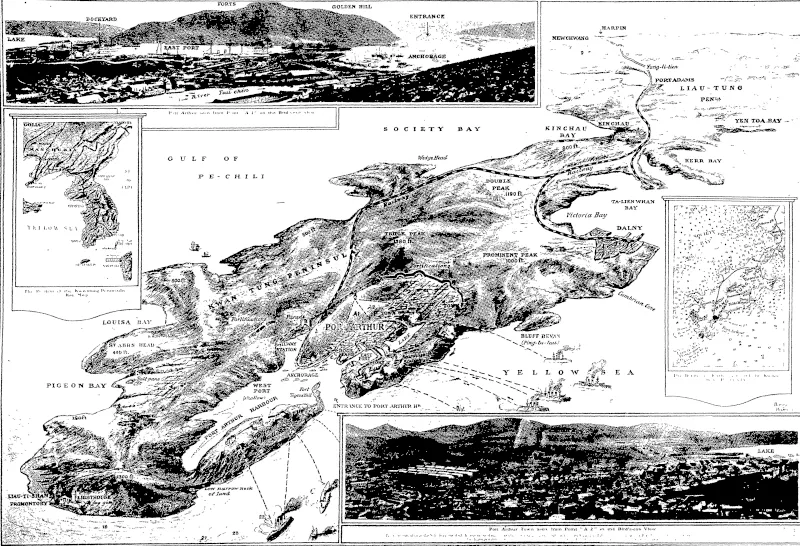
THE RUSSO-JAPANESE WAR: ISOLATION OF PORT ARTHUR— ONi THREE SIDES IS THE SEA, ON THE FOURTH THE ENEMY. The central picture is a bird's-eye view of the Kwan-Tung Peninsula, and gives the reader a capital idea of the position of Port Arthur and its fortifications, as well as its relation to the different landing places, the names of which have figured so prominently in connection with the operations of the Japanese. The long views of Port Arthur at top and bottom are continuous: half the lake appears in one view, half in the other. Both views "are taken from the point marked "A" on the bird's-eye view—one looking to the N.E., and the other S.E. In the lower view the town stretches to the N.E. in the direction of Dalny, the large commercial city formerly known, as Talienwan. The picture, which if* from a recent panoramic view, shows the Russian extensions since the time when it was in the hands of the Chinese, who -were themselves using it as a naval base. On tihe left is a small key map, giving the position of the Kwan-Tung Peninsula shown on a large scale in the bird's-eye view; on the right is a plan giving the depths in fathoms round the Kwan-Tung Peninsula.—From the Sphere. (Otago Witness, 22 June 1904)
About this item
- Title
- THE RUSSO-JAPANESE WAR: ISOLATION OF PORT ARTHUR— ONi THREE SIDES IS THE SEA, ON THE FOURTH THE ENEMY. The central picture is a bird's-eye view of the Kwan-Tung Peninsula, and gives the reader a capital idea of the position of Port Arthur and its fortifications, as well as its relation to the different landing places, the names of which have figured so prominently in connection with the operations of the Japanese. The long views of Port Arthur at top and bottom are continuous: half the lake appears in one view, half in the other. Both views "are taken from the point marked "A" on the bird's-eye view—one looking to the N.E., and the other S.E. In the lower view the town stretches to the N.E. in the direction of Dalny, the large commercial city formerly known, as Talienwan. The picture, which if* from a recent panoramic view, shows the Russian extensions since the time when it was in the hands of the Chinese, who -were themselves using it as a naval base. On tihe left is a small key map, giving the position of the Kwan-Tung Peninsula shown on a large scale in the bird's-eye view; on the right is a plan giving the depths in fathoms round the Kwan-Tung Peninsula.—From the Sphere. (Otago Witness, 22 June 1904)
- Content partner
- National Library of New Zealand
- Collection
- Papers Past
- Format
- Image
- Date created
- 22-06-1904
- URL
- https://paperspast.natlib.govt.nz/newspapers/OW19040622.2.145.10
- Locations
- New Zealand
What can I do with this item?
Check copyright status and what you can do with this item
Check informationReport this item
If you believe this item breaches our terms of use please report this item
Report this itemDigitalNZ brings together more than 30 million items from institutions so that they are easy to find and use. This information is the best information we could find on this item. This item was added on 20 April 2012, and updated 06 July 2018.
Learn more about how we work.
Share
What is the copyright status of this item?

Share, Modify, Use commercially
See below for specifics about how you may use this item.

More Information
National Library of New Zealand has this to say about the rights status of this item:
No known copyright restrictions
What can I do with this item?
You must always check with National Library of New Zealand to confirm the specific terms of use, but this is our understanding:

Non-infringing use
NZ Copyright law does not prevent every use of a copyright work. You should consider what you can and cannot do with a copyright work.

Share it
This item is suitable for copying and sharing with others, without further permission.

Modify it
This item is suitable for modifying, remixing and building upon, without further permission.

Use it commercially
This item is suitable for commercial use, without further permission.
What can I do with this item?
Check copyright status and what you can do with this item
Check informationReport this item
If you believe this item breaches our terms of use please report this item
Report this itemDigitalNZ brings together more than 30 million items from institutions so that they are easy to find and use. This information is the best information we could find on this item. This item was added on 20 April 2012, and updated 06 July 2018.
Learn more about how we work.
Share
Related items
Loading...