Image
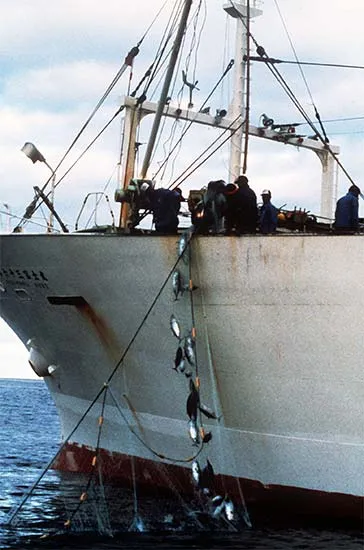
Japanese tuna boats
About this item
- Title
- Japanese tuna boats
- Content partner
- Manatū Taonga, the Ministry for Culture and Heritage
- Collection
- Te Ara - The Encyclopedia of New Zealand
- Description
At the 1974 Law of the Sea conference, New Zealand and Pacific nations argued for the right of all states to manage their high-seas fisheries. This principle was behind a case taken by New Zealand and Australia to the International Tribunal for the Law of the Sea in 1999. They wanted to stop Japan carrying out experimental fishing of the seriously depleted southern blue-fin tuna. The tribunal decided it did not have jurisdiction, and Japanese vessels like this one, photographed in 2005, conti...
- Format
- Image
- Date created
- 2 March 2009
- Creator
- Lorette Dorreboom
- Contributing partner
- Greenpeace International
- URL
- https://teara.govt.nz/en/photograph/6965/japanese-tuna-boats
What can I do with this item?
Check copyright status and what you can do with this item
Check informationReport this item
If you believe this item breaches our terms of use please report this item
Report this itemDigitalNZ brings together more than 30 million items from institutions so that they are easy to find and use. This information is the best information we could find on this item. This item was added on 19 April 2013, and updated 28 November 2025.
Learn more about how we work.
Share
What is the copyright status of this item?

Share, Modify
See below for specifics about how you may use this item.

More Information
Manatū Taonga, the Ministry for Culture and Heritage has this to say about the rights status of this item:
http://www.teara.govt.nz/copyright, Crown Copyright administered through the New Zealand Ministry for Culture and Heritage Te Manatu Taonga. All text licensed under the Creative Commons Attribution-NonCommercial 3.0 New Zealand Licence unless otherwise stated. Commercial re-use may be allowed on request. All non-text content is subject to specific conditions. Greenpeace International by Lorette Dorreboom This item has been provided for private study purposes (such as school projects, family and local history research) and any published reproduction (print or electronic) may infringe copyright law. It is the responsibility of the user of any material to obtain clearance from the copyright holder.
What can I do with this item?
You must always check with Manatū Taonga, the Ministry for Culture and Heritage to confirm the specific terms of use, but this is our understanding:

Non-infringing use
NZ Copyright law does not prevent every use of a copyright work. You should consider what you can and cannot do with a copyright work.

Share it
This item is suitable for copying and sharing with others, without further permission.

Modify it
This item is suitable for modifying, remixing and building upon, without further permission.

No commercial use
You may not use this item commercially.
What can I do with this item?
Check copyright status and what you can do with this item
Check informationReport this item
If you believe this item breaches our terms of use please report this item
Report this itemDigitalNZ brings together more than 30 million items from institutions so that they are easy to find and use. This information is the best information we could find on this item. This item was added on 19 April 2013, and updated 28 November 2025.
Learn more about how we work.
Share
Related items
Loading...