Hist243 - Fashion and identity
A DigitalNZ Story by Alison Grooby
By Alison Grooby
Fashion has historically been a cultural tool allowing expression of traditions and communication of self-identity. The visual representation that clothes bring in relation to one’s identity, time period, and what or who they identify with, has defined humanity since early humans began adorning their bodies with materials. When studying history, we closely relate time periods and cultures to what was being worn at the time. In New Zealand, the intersection between Maori and European culture is starkly represented by the early interactions that took place. Perhaps often overlooked in favour of events and what was being said, fashion was an unspoken representation of culture and group belonging. Maori fashion had close ties to the land, the use of flax as a primary fibre and feather of native birds were widely relied upon. Europeans were in stark contrast, being clothed in the fashions brought from Britain. The origins of ‘Kiwi Culture’ can be better understood when studying the subtleties that helped shape the meaning today.
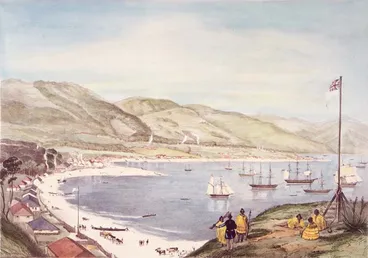
Colonising landscape, Wellington 1841.
Colonising the landscape
Manatū Taonga, the Ministry for Culture and Heritage
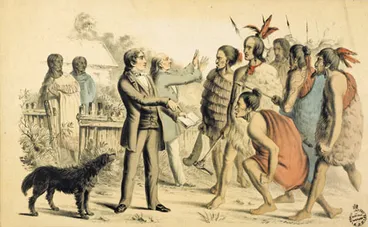
Meetings between Maori and European, showing the contrast in ways of dress, illustration from 1856.
Missionaries as peacemakers
Manatū Taonga, the Ministry for Culture and Heritage
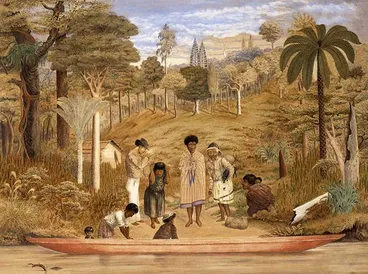
Māori in traditional and European dress, 1864
Manatū Taonga, the Ministry for Culture and Heritage
![Image: [New Zealand Tourist Department?] :Fashions of the Kaianga. March 1933.](https://images.digitalnz.org/9U0zzS_pfps6ucwAJ-l1R67tfDI=/368x0/https%3A%2F%2Fndhadeliver.natlib.govt.nz%2FNLNZStreamGate%2Fget%3Fdps_pid%3DIE136443 "[New Zealand Tourist Department?] :Fashions of the Kaianga. March 1933.")
Maori women in traditional dress, adorned with many native bird feathers and use of flax fibre, March 1933.
[New Zealand Tourist Department?] :Fashions of the Kaianga. March 1933.
Alexander Turnbull Library
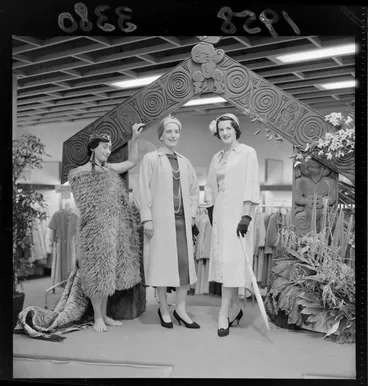
Maori and European women showing cultural variances in dress, 9th October 1958.
Fashion display with fake Maori backdrop at Kirkcaldie & Stains department store, Wellington, featuring models in coats and a woman in traditional ...
Alexander Turnbull Library
The Europeans of the colonial landscape took it upon themselves to start a ‘civilising’ process [Richards, 2017, p.292]. Women were anything but complicit in their proliferation of ‘proper’ dress. The ideals of Britain and their definition of femininity through fashion was entirely translated to New Zealand, showing that clothing was one of the subtle forms of control and regulation [Richards, 2017, p.292]. The Maori people, and the New Zealand frontier was described as “Dark, barbaric, and wild, in need of taming and civilising” [Richards, 2017, p.293]. British ideas of femininity were “..to contribute to the refinement of an unrefined culture, people, and landscape” [Richards, 2017, p.294]. The attempt to domesticate Maori bodies was carried out through the church and education, passing on ideas about what behaviour is appropriate, and ways of dress and appearance [Cozens, 2014, p.528]. European clothing of this period was linked to ideas about morality. A hallmark of colonisation is control over the people already occupying the land, and Europeans imagined the only path to peace with Maori was to impose upon them an imagined idea of a moral and civilised society, albeit in a Eurocentric context [Cozens, 2014, p.528]. Not only was the British way of life promoted, by many the Maori way of life was renounced, whether explicitly stated or not, as savage and unrefined. A Maori child described as “young savage” [Cozens,2014, p.533] and feathers as a clothing material was stated to be “trappings of the savage” [Hunter, 2011, p.95]. The sophistication needed in order to create Ta moko, and intricate weaving and utilisation of materials of nature was largely lost on the early European settlers, with some few exceptions. The ‘civilisation’ process through ways of dress was one aspect in which New Zealand settlers imagined this place as an extension of Britain. Using dress to preserving a class society was one of the many processes of colonisation [Richards, 2017, p.292], and it shows the close association between fashion, class and identity.
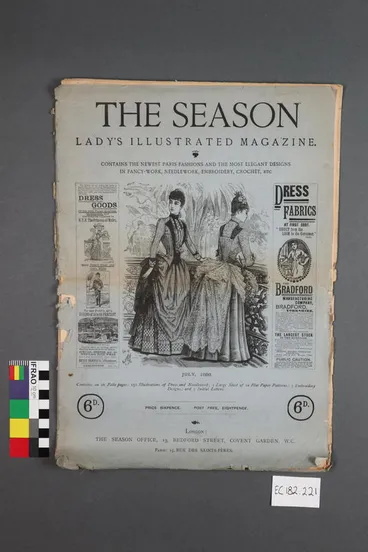
Women's fashion magazine, showcasing European styles of dress and fabrics as the standard of beauty, July 1886.
magazine, women's fashion
Canterbury Museum
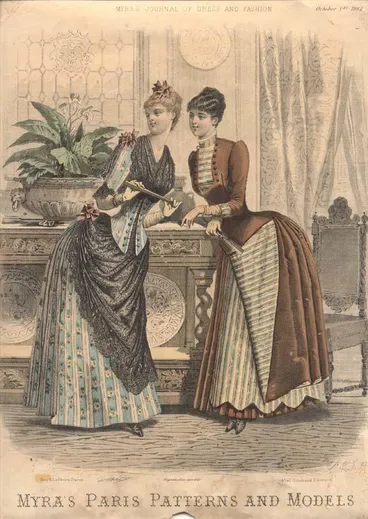
Picture taken from women's fashion magazine showcasing the ideal styles of the period.
Ad, Fashion
Puke Ariki
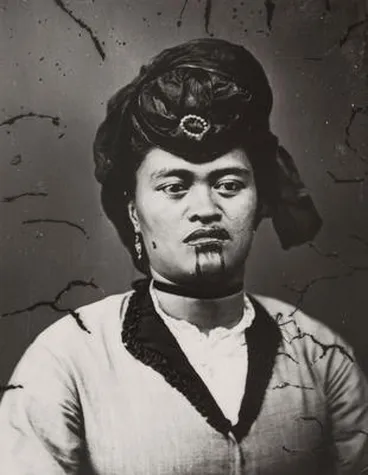
Maori woman with Tā moko, dressed in European clothing, ca 1869.
Maori Woman with Moko
Auckland Art Gallery Toi o Tāmaki
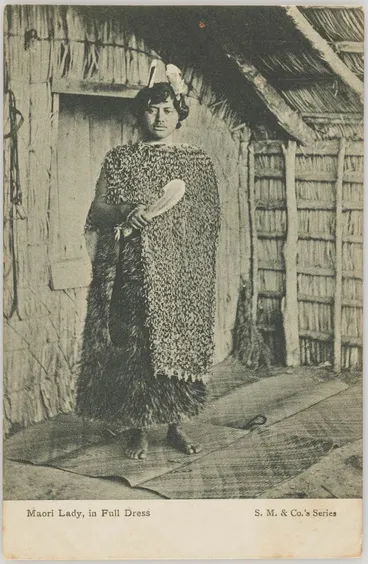
Example of use of bird feathers in traditional Maori clothing, ca 1905.
Maori Lady, in Full Dress
Museum of New Zealand Te Papa Tongarewa
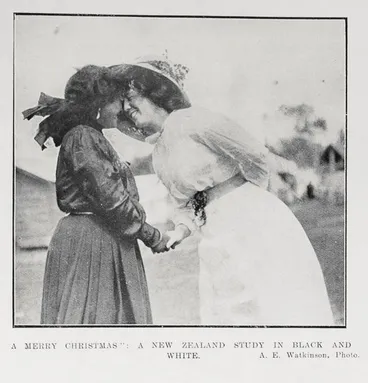
Mixing of cultures: Maori and European women both in European dress, performing the hongi (traditional Maori greeting).
A merry Christmas
Auckland Libraries
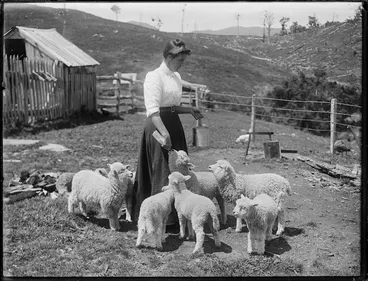
Not only did the British try to shape Maori ideas of dress, the land began to shape the ways in which the British dressed themselves. Life on the land required clothes of a practical nature, something in New Zealand culture that remains to this day. The need for practical and functional clothes, like many things in New Zealand, relates back to the landscape. Women especially experienced the trade off between fashion and functionality, but attempted valiantly to preserve the former. Work was required of both men and women, which meant dressing very differently to how it was done in England [Richards, 2017, p.292]. Practicality was the basis upon which ideas around clothing were built [Richards, 2017, p.294].The correlations between dress and sense of place were strong for the people living on the land.
The land still today shapes the materials we associate with ‘Kiwi Culture’. Wool, especially merino, is a functional fibre that allows one to be kept cool when warm, and warm when it is cold. The use of wool, and reliance upon natural fibres as a whole, provides an understanding of the ties New Zealanders have to the landscape. For Maori, the traditional use of flax and feathers is a direct tie to the land. The practise of returning unused flax to the bush gives an insight into the sacred and respectful practises carried out. New Zealanders relate to the land in varying ways, but this connection was always, historically, reflected in the clothes that were worn.
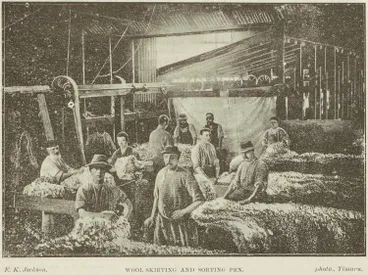
Wool skirting and sorting pen, Timaru, 14th January 1893
Wool skirting and sorting pen
Auckland Libraries
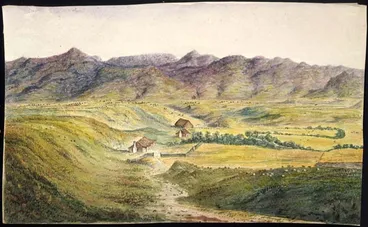
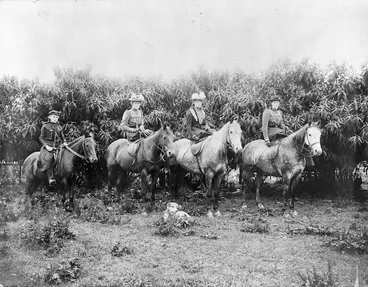
Women riding sidesaddle to accomodate wearing dresses on horseback, ca 1900.
Exley sisters
Alexander Turnbull Library
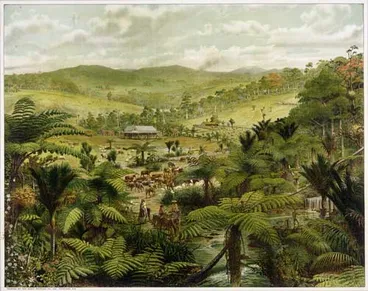
Wild landscape of New Zealand, with many fern plants in foreground.
North Island sheep and cattle farming
Manatū Taonga, the Ministry for Culture and Heritage
Black could be described as the national colour of New Zealand. It began in colonial times and John R. Harvey, p.10 [as cited in Richards, 2017, p.300] states that black is “the colour without colour… …the colour of humility, or guilt, of shame”. In fashion black is described as an intrinsic aspect of fostering social order in the colony [Richards, 2017, p.300]. It was a blatant indicator of social status in colonial times [Richards, 2017, p.300]. The colour black up until the mid-nineteenth century was a marker of high-status and of prestige [Richards, 2017, p.301]. This was such due to it being the most expensive and time-consuming colour to dye into clothing. [De Pont, 2012, p.12]. Although synthetic dyes began to develop and in the time period of 1856 - 1863 which meant the availability of black fabric was far more accessible to all classes [De Pont, 2012, pp.12-13, & Richards, 2017, p.301]. Black is described as a paradox colour, one which is no colour at all [Richards, 2017, p.301]. The colonial world was full of paradox, the relationship between “familiarity and unfamiliarity, civilisation and wildness” [Richards, 2017 p.301]. New Zealand it seems was founded upon this unease, the unknown and the sense of, or lack thereof, belonging. Today black is closely tied to the culture of New Zealand, if not more so than within sport [Daley, 2012, p117]. The All Blacks with their distinctive monochromatic uniforms, as well as the Black Caps and others, are set far apart from the colours adopted by international sports teams. The fern in sport has become a national insignia. The fern is immediately recognisable and shows that today New Zealanders still hold close ties to the land and the iconography of nature. New Zealand tends to have a distinctive style [Molloy, 2004, p.9]. The culture of our fashion is a crossroads between the paradoxes of practicality and style, rural and cityscape, international sociocultural trends and our own nostalgia. Perhaps the history behind the reliance of the colour black relates closely to the struggle for self-acceptance and forging a new identity, the coming together of cultures, and the complexities of the past, which is now proudly worn by a nation as it has become part of the New Zealand identity in itself.
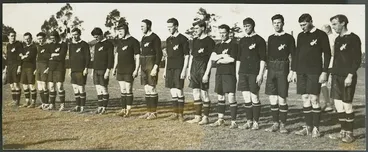
All Blacks team, wearing black uniform with fern, 1921
All Blacks rugby team
Alexander Turnbull Library
Kiwi culture today is a culmination of early colonial interactions and ties to the New Zealand landscape. Fashion is not merely a powerful outlet for expressing identity, it is also a way to carry tradition and tell stories of the past, especially for Maori people. Traditional depictions of ‘Kiwi Culture’ can be understood on a deeper level when the processes around their creation are studied and understood. The struggle for identity throughout New Zealand, and the proliferation of ‘cultural cringe’ or believing one’s own culture to be inferior in relation to another, is a process of the young age of New Zealand as a settled country still coming to terms with its past and place and role in the world.
Bibliography
Caroline Daley, Taking Off the Black Singlet, New Zealand Journal of History, 2012, pp.113–128. Retrieved from <http://ezproxy.canterbury.ac.nz/login?url=https://search.ebscohost.com/login.aspx?direct=true&db=hlh&AN=90024696&site=ehost-live>
Doris De Pont, Why Do We Wear Black?, Black: The History of Black in Fashion, Society and Culture in New Zealand, Auckland: Penguin Books, 2012.
Harriette Richards, Reading Lady Barker: Fashioning Femininity in Colonial New Zealand, Western Sydney University, 2017. Retrieved from <http://search.proquest.com.ezproxy.canterbury.ac.nz/docview/2186487692?accountid=14499>
Kate Hunter, A bird in the hand: Hunting, fashion and colonial culture,Journal of New Zealand Studies No. 12, 2011, pp.91-105. Retrieved from <https://search-informit-com-au.ezproxy.canterbury.ac.nz/documentSummary;dn=264670965956483;res=IELHSS>
Maureen Molloy, Cutting-edge Nostalgia: New Zealand Fashion Design at the New Millennium, Fashion Theory: The Journal of Dress, Body & Culture, 2004, pp. 477–490. Retrieved from <https://web-a-ebscohost-com.ezproxy.canterbury.ac.nz/ehost/pdfviewer/pdfviewer?vid=1&sid=77c105f9-9f25-458a-bfb9-b51590f707c9%40sessionmgr4006>