Dame Whina Cooper: Story In photos
A DigitalNZ Story by Zokoroa
A photographic journey of Dame Whina Cooper
Dame Whina Cooper, Whina Cooper, 1975 land march, land march, hikoi, protest, Maori land protest, Maori leaders, women, New Zealanders
"Woman of mana, teacher, storekeeper, community leader"
The description above was written by Michael King in Te Ara: Dictionary of New Zealand Biography. Dame Whina Cooper, of Te Rarawa descent, was born on 9 December 1895 in northern Hokianga. She was a land activist, noted Māori leader and respected kuia (elder). Her endeavours included leading the national hikoi / land march in 1975 which left Te Hāpua in Far North on 14 September and arrived 1,100 kms later at Parliament in Wellington on 13 October. Dame Whina died at Panguru on 26 March 1994. She told an interviewer on her 98th birthday that her last wish was, "Before I close my eyes, to see our Māori people understand the two races in New Zealand will love . . . that's what you want, that love between two people." (See Independent: Obituary)

Dame Whina Cooper (1895-1994) - Te Whaea o te Motu (Mother of the Nation)
Appointed MBE (1953), CBE (1974), DBE (1981) & a member of the Order of New Zealand in 1991. (Photo taken 25 Sept 1975)
National Library of New Zealand

National inspiration: Whina & mokopuna setting off on hikoi/land march from Te Hāpua in Far North to Parliament (1975)
(Whina aged 79 & 3 year old granddaughter Irenee Cooper were photographed by NZ's Herald's Michael Tubberty)
Manatū Taonga, the Ministry for Culture and Heritage
1. Early years: 1895 - 1916
"Dame Whina Cooper was born Hōhepine (Josephine) Te Wake at Te Karaka in northern Hokianga on 9 December 1895. Her father was Heremia Te Wake, a leader of Ngāti Manawa and Te Kaitutae hapu of Te Rarawa and the son of an American whaler. Her mother, Kare Pauro Kawatihi, was of Te Rarawa and Taranaki descent. Whina was the first child of her father’s second marriage. Another daughter, Heretute, was born in 1897, and there were four half-brothers and three half-sisters from Heremia’s first family."
Source: Michael King. 'Cooper, Whina', Dictionary of New Zealand Biography, first published in 2000. Te Ara - the Encyclopedia of New Zealand, https://teara.govt.nz/en/biographies/5c32/cooper-whina

Dame Whina Cooper was born Hōhepine (Josephine) Te Wake on 9 December 1895
Whina was born at Te Karaka in northern Hokianga, and died at Panguru on 26 March 1994
Alexander Turnbull Library
Whina's parents Heremia and Kare Te Wake
Whina's parents were Heremia Te Wake & Kare Pauro Kawatihi who married in 1894. (Kare was Heremia's 2d wife)
(He'd married his first wife Maraea (Maraia) Topia in 1853 & they had 7 children - four sons & three daughters)
Manatū Taonga, the Ministry for Culture and Heritage
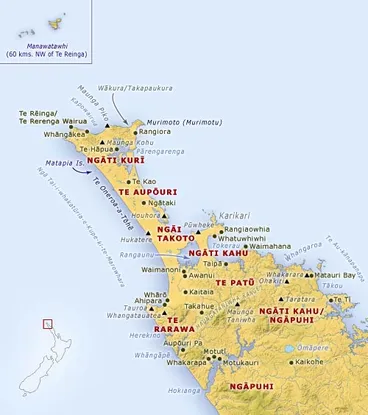
Kare (c.1838-1917) of Te Rarawa & Taranaki descent was born at Te Karaka in Hokianga Harbour on west coast of Northland
(Map of 6 tribes of Muriwhenua: Ngāti Kurī, Ngāi Takoto, Te Pātū, Ngāti Kahu, Te Aupōuri & Te Rarawa)
Manatū Taonga, the Ministry for Culture and Heritage
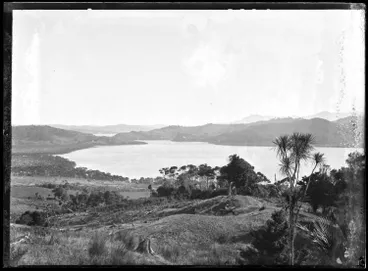
Heremia (c.1835-1918) was born at Te Karaka to William Hoard (ex-whaler born in Vermont, USA) & Te Oki Mahu of Te Rarawa
(Te Oki's hapū: Ngāti Manawa & Te Kaitūtae.) They'd married in 1832 & Heremia was the 2nd of 11 children.
Auckland Libraries
Heremia (also known as 'Piri Hoa') was a farmer, a Catholic catechist, & leader of Te Kaitūtae & Ngāti Manawha hapū
He was also appointed as a Native Land Court assessor in 1886 under the Resident Magistrates Act 1867
National Library of New Zealand
Te Wake family lived at Te Karaka & then moved to Whakarapa (Panguru) in 1904
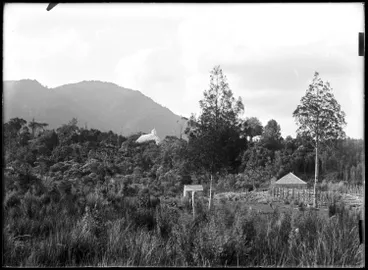
On 8 Dec 1895, Whina was born at Te Karaka & baptised on 15 Dec at Saint Peters Church in Whakarapa
The white steepled Catholic Church had been built by Heremia, Father McDonald & local iwi; & opened in 1883
Auckland Libraries
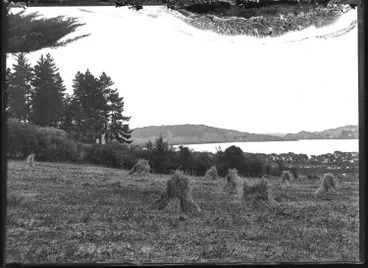
In 1897, Whina's sister Heretute was born and they spent their early childhood on the family's farm at Te Karaka
Auckland Libraries
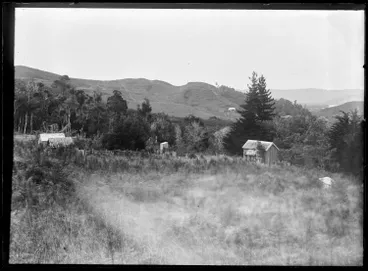
In 1902, Whina began attending Whakarapa Native School at c.7 years & would walk 6 miles from Te Karaka
(Image of farm in Hokianga district)
Auckland Libraries
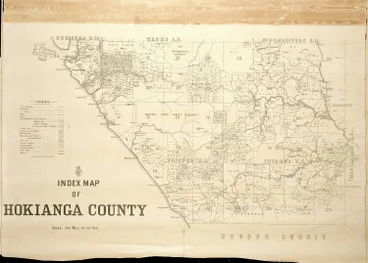
When Whina was nine years old, the family moved to Whakarapa (renamed Panguru in 1923)
Auckland Libraries
Secondary schooling at St Joseph’s Māori Girls’ College in Napier, 1907 - 1911

From 1907, Whina attended St Joseph’s Māori Girls’ College in Napier with sponsorship from Sir James Carroll
A devout Catholic, Whina's father let Carroll (Māori Minister of Native Affairs) know his wish to send Whina to College
Auckland Libraries
Embarks on career moves, 1911 - 1916

1911: Whina returned from Napier to Whakarapa to live with her parents & work at their co-operative store
At school, she'd learnt to keep records & accounts, write correspondence, take recitation, cook & sew, & played sport
Auckland Libraries

Whina's father wanted her to marry widowed Tureiti Te Heuheu Tukino V, leader of Ngāti Tūwharetoa, but she refused
Tūreiti's wife Te Rerehau Kahotea had died on 3 Nov 1911. Whina refused to agree to an arranged marriage.
Alexander Turnbull Library

1913-1914: Whina was a trainee teacher at Pawarenga Native School (10 kms north of Whakarapa); then decided to leave
She was the only Māori of 3 teachers; parents often rotated which child attended; & her own community required her help
Manatū Taonga, the Ministry for Culture and Heritage

c.1914: Whina & her father, aided by Northern Māori MP Peter Buck, campaigned against farmer draining Whakarapa mudflats
Farmer Bob Holland's lease was challenged through Parliament & court system as area used to gather seafood & race horses
Auckland Libraries

Buck's successor, Taurekareka (Tau) Henare (1914-38), also intervened until farmer's lease was withdrawn by Marine Dept
Whilst awaiting legal outcome, Whina led a group to fill in drains as these were dug by the farmer & were trespassed
Alexander Turnbull Library
Whina's sister Heretute met Aperahama (Hemi) Witana (b.1896) & they had a child in 1915 before he served overseas in WW1
Witana served as a Private with 22nd Reinforcements of New Zealand Māori (Pioneer) Battalion, embarking on 13 Oct 1917
Auckland War Memorial Museum Tāmaki Paenga Hira
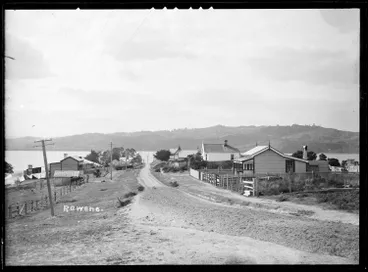
In 1915, Whina went to Rawene where she became the housekeeper at Catholic presbytery built by Father Charles Kreymborg
Kreymborg (born c.1868 in Netherlands) had joined St. Joseph's Foreign Missionary Society of Mill Hill, London in 1893
Auckland Libraries
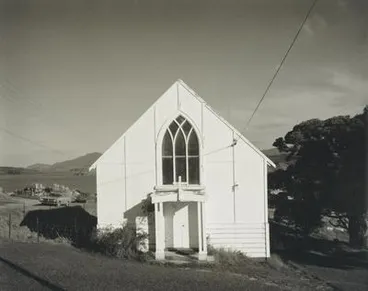
Whina considered entering a convent to become a nun but changed her mind on seeing a nun harshly mistreating a child
Image: Church in Rawene built by Kreymborg (known as Pā Karora) who also built other churches, schools & presbyteries
Auckland Art Gallery Toi o Tāmaki
2. Marriage & family life at Whakarapa (Panguru) & Te Karaka: 1916 - 1919
Whina met & married Richard Gilbert & lived on her parent's farm at Whakarapa

In 1916, Whina returned to Whakarapa to work in family's store & met Native Land Court surveyor Richard Tuhaia Gilbert
Richard was born on 18 Dec 1891 in Waipa & was of Te Waiariki of Ngāti Wai in the Ngunguru district
Manatū Taonga, the Ministry for Culture and Heritage
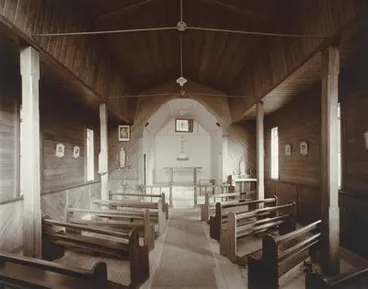
Whina took Richard to Rawene to be married by Father Kreymborg with Richard's brother Moses as witness on 10 May 1917
As only Whina's parents were told beforehand, the news had a mixed reaction from the community & Whina's siblings
Auckland Art Gallery Toi o Tāmaki
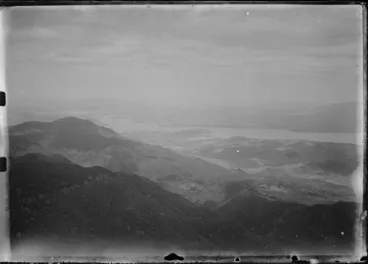
They lived at Whina's parents' home on family farm at Whakarapa. Soon after, Whina's mother Kare died in June 1917.
Whina & Richard helped with the agricultural work & milking the cows; & running the local co-operative store
Auckland Libraries
Son Gerard born in Dec 1917 & daughter Carla during 1918
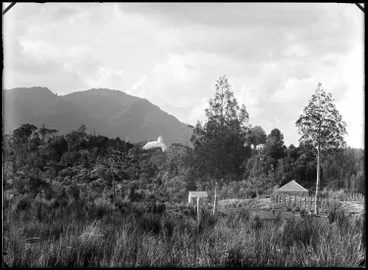
Their son Gerard Tuhaia Gilbert was born on 10 Dec 1917 & their daughter Carla Maude Te Morehu Gilbert in 1918
Source: FamilySearch: https://www.familysearch.org/en/newzealand/
Auckland Libraries
After Whina's father died in Nov 1918, evicted from family home & moved to Te Karaka
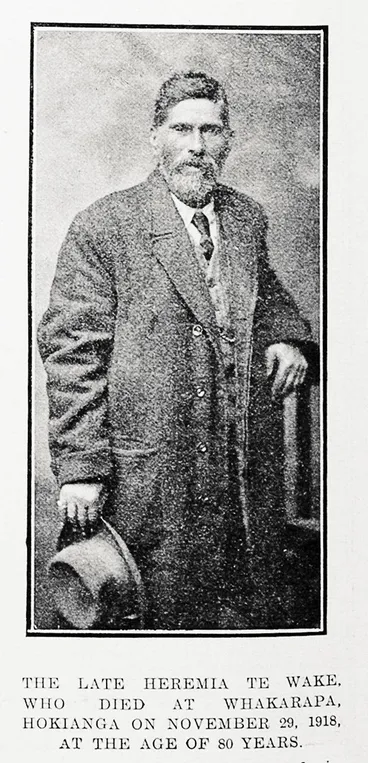
On 29 Nov 1918, Whina's father Heremia died of influenza & they were evicted from her parents' home by her step-brothers
As her father hadn't changed his will since remarrying, his children from his first marriage inherited his property
Auckland Libraries

Whina, Richard & children went to Te Karaka; built a nīkau whare on family land & Whina worked at the local gumfields
Alexander Turnbull Library
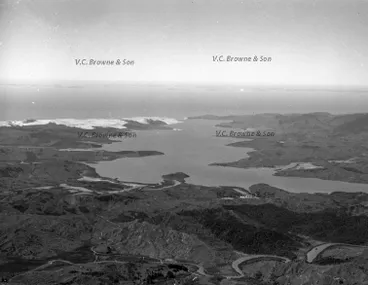
Richard worked as a timber worker at Tapuwae during the week, returning home on the weekends
V.C. Browne & Son
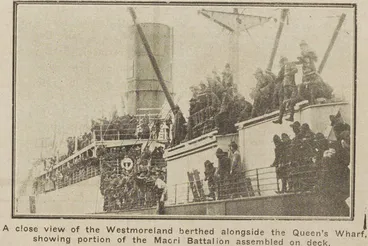
On 13 Oct 1919, Whina's sister Heretute married Aperahama Witana after he returned with the Māori Battalion in April
The following year, Heretute gave birth to the second of their nine children. (See FamilySearch website)
Auckland Libraries
3. Moved back to Whakarapa (Panguru) & had business success from 1920s onwards
Purchased Whina's parents' family home & farm, & developed stores, 1920 -
In 1920, Charles Kreymborg who'd become a Parish Priest offered to lend part of his family inheritance to aid Whina
(Article: Later in June 1920, Kreymborg took 12 months leave to visit his hometown in Holland, Netherlands)
National Library of New Zealand

Whina & Richard purchased the family house & farm from her step-brothers & the village store at Whakarapa (Panguru)
They intended to repay the loan to Kreymborg from their income from the farm & shop, which they achieved within 3 years
Auckland Libraries

After repaying the loan, they built a new shop & storeroom, added a post office, & opened branches at Waihou & Mitimiti
Whina imported goods from UK; exported kauri gum & Jew’s ear fungus (Auricularia polytricha) & acquired a launch & truck
Alexander Turnbull Library
Name 'Whakarapa' changed to 'Panguru' following Whina calling public meeting, 1923

1923: Whina called a public meeting that resulted in the name Whakarapa being renamed Panguru
Name change was to distinguish it from Whakapara north of Whangārei. It was named after the local mountain Mt Panguru.
Auckland War Memorial Museum Tāmaki Paenga Hira

Whina & Richard purchased a second farm at Tautehere & replaced their dairy herds
They built new milking sheds, & bred pedigree Jersey cows
Auckland Libraries

Whina also had a leading role in church & community activities
A women’s committee worked with Sisters of St Joseph of the Sacred Heart to organise hui, tangihanga and fund-raising
Auckland War Memorial Museum Tāmaki Paenga Hira
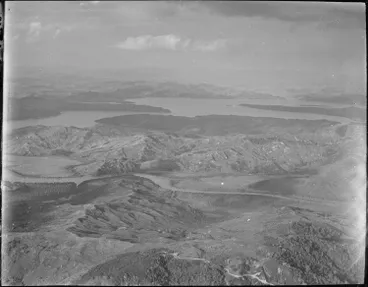
As women were discouraged to speak on the marae, Whina opened her community centre called 'Parish Hall' next to her shop
Women could gather & speak & Whina share her views on community matters etc in the Hall. (Image: Panguru in foreground)
Auckland Libraries

Whina also built a clinic alongside the store to enable medical services to be more readily available
Patients were seen by Dr G. M. Smith’s Hokianga Health Service staff team who were based at the Rawene Hospital
Ngā Taonga Sound & Vision

In 1928, Whina discovered Richard & her married sister Heretute had an affair. However, Whina decided to stay with him.
Family rift was included in film "Whina" (2022). (Heretute was still married to Aperahama Witana & they had 4 children.)
NZ On Screen

Whina's sporting interests: playing hockey, netball, table tennis, fishing, shooting, & coaching rugby & basketball
Image: Whina & companion wearing kahu huruhuru possibly at a sports event in 1930s-40s
Auckland Libraries
4. Māori Land development schemes: 1928 - 1930s
On 7 Nov 1928, the Native Land Amendment and Native Land Claims Adjustment Act set up the Native Land Development scheme
Following the passage of the Act, the Govt began offering state-funded loans to help Māori develop & farm their own land
The University of Auckland Library
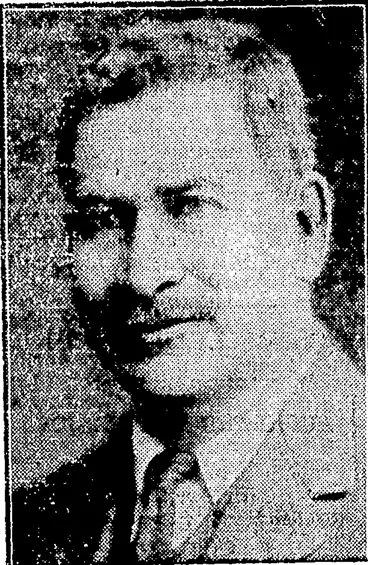
On 10 Dec 1928, Sir Āpirana Ngata became Minister of Native Affairs & appointed Bill Cooper as a Land Officer
Bill had been on 1927 Royal Commission on confiscated Māori land & his new role was land consolidation in Tai Tokerau
National Library of New Zealand
Bill (William) Turakiuta Cooper of Ngāti Kahungunu & European descent was born at Muriwai, Poverty Bay in c.1885
His wife was Margaret (Maggie) Te Uira Paewa whom he married in Gisborne in 1918 & they had no children
Manatū Taonga, the Ministry for Culture and Heritage

In June 1932, Whina attended Land Development Conference held at Rotorua at the invite of Ngata & she met Cooper
Ngata showed how the 1928 legislation enabled Māori to borrow money to clear, drain, grass & fence land
Manatū Taonga, the Ministry for Culture and Heritage

In Aug 1932, Sir Āpirana spoke at a public meeting at Whina's Parish Hall to launch Māori land development schemes
Ngata had asked Whina's opinion at Rotorua & she answered: “Give us the help (money) and we'll beat you.” (Te Ao Hou)
Alexander Turnbull Library

After the meeting, which Cooper had attended, Hokianga district was partitioned into 11 Māori land development schemes
Of the 98,000 acres in the Hokianga district, 7,000 acres were in Panguru, Waihou & Motuti
Manatū Taonga, the Ministry for Culture and Heritage

Whina became the official supervisor of Panguru & Waihou where ohu (communal working bees) were used to establish farms
In Panguru, a working bee of 80 carried out community farmwork, from one farm to the next—clearing, fencing, & drainage
MOTAT
For advice on breeding stock, Whina contacted Princess Te Puea who'd aided communal dairy farming in Franklin district
National Library of New Zealand

Princess Te Puea sent a breeding sow and boar to Whina to help start a pig-farming venture
Alexander Turnbull Library

During 1932, Whina became an adviser to Bill Cooper in his land consolidation inspection tours in Hokianga & Northland
Bill gave advice on shared ownership of viable land & arranged for surveys, bush & scrub clearance, fencing & roading
Auckland Libraries

In 1933, Ngata, PM George Forbes, Māori leaders & Hokianga County Council staff visited the area with Whina (front left)
An Auckland Star journalist noted Whina was ‘the driving force’ at Panguru and the ‘amazon excavator' (Papers Past)
Alexander Turnbull Library
5. Widowed Whina moved from Panguru with Bill Cooper, late 1935/early 1936
Husband Richard Gilbert died March 1935
March 1935: Whina's husband Richard Gilbert died aged 43 years due to ill-health following cancer
Auckland Art Gallery Toi o Tāmaki
Whina pregnant to Bill Cooper & they move to Kamo in Northland, c.1935
Whina publicly announced she was pregnant to Bill Cooper & that they intended to marry once he obtained a divorce
Whina was 7 months pregnant to Bill who was still married to his wife Margaret with whom he did not have children
Manatū Taonga, the Ministry for Culture and Heritage
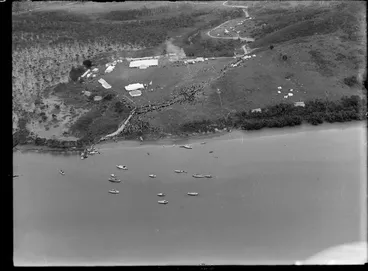
As Bill was already married & Whina a devout Catholic, the news caused a scandal & they decided to leave
(Bill had been raised by his parents within the Anglican faith.)
Alexander Turnbull Library
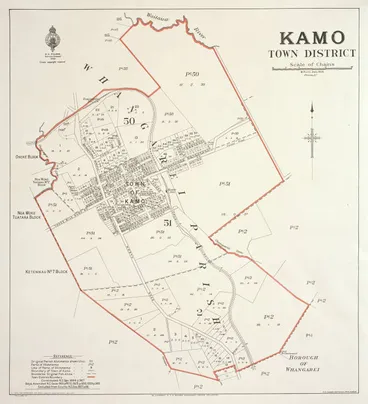
After obtaining a separation from his wife, Bill & Whina moved to Kamo in Northland & by 1937 had their 2d child
They raised Whina's two Gilbert children & their son Hohepa (Joseph) (b.1935) & daughter Hinerangi (b.29 May 1937)
Auckland Libraries
Whina & Bill then moved to Ōtiria in Northland & third child born in Jan 1938

Whina & Bill moved from Kamo to the rural town Ōtiria and their third child was born
Their second daughter Merekaraka was born on 7 Jan 1938
Alexander Turnbull Library

Whina & Bill arranged renovation of Te Porowini meeting house at Ōtira Marae at Moerewa (56.33kms east of Panguru)
Te Porowini was built in 1876 at Taumārere & moved to Ōtira Marae in 1904
Alexander Turnbull Library
Bill also became involved with building other Ōtiria meeting houses in his Land Officer role with Dpt of Native Affairs
Bill's involvement was later acknowledged in an article in Te Ao Hou (No. 3, Summer 1953)
Alexander Turnbull Library

6 Feb 1940: Whina organised catering for opening of meeting house Te Whare Rūnanga at Waitangi
It was opened on the centennial date of the signing of Treaty. Whina crossed threshold first in tapu removal ceremony.
Alexander Turnbull Library
6. Whina & Bill married at Ōtiria in Feb 1941 & 4th child born in June 1941
21 Feb 1941: At Ōtiria, Whina married Bill Cooper on the day his marriage was annulled by the Catholic Church
He'd converted from being Anglican to Catholic. Their fourth child, Nopera Tau Henare William, was born on 5 June 1941
Manatū Taonga, the Ministry for Culture and Heritage
7. Whina & Bill Cooper & their four children returned to Panguru in 1942

1942: They returned to Panguru & Whina helped with fund-raising for the Māori War Effort Organisation
Whina "established close relationships with the minister in charge, Paraire Paikea, and with Te Puea Herangi". (Te Ara)
Manatū Taonga, the Ministry for Culture and Heritage

On 25 Jan 1946, Whina spoke at pōwhiri welcoming home members of (28) Māori Battalion at Te Kotahitanga marae at Kaikohe
Alexander Turnbull Library
On 1 April 1946, Māori Social and Economic Advancement Act 1945 came into force to set up Tribal Districts & Committees
Aims were social, economic, health & general well-being of the Māori Community, overseen by Dpt of Native Affairs
Victoria University of Wellington
1946-1952: Whina was secretary & trustee of the Panguru Tribal Executive Committee
She worked on regional advocacy, supporting community welfare, local farming initiatives, & Māori land development
Alexander Turnbull Library

April 1947: Whina was elected president of North Hokianga Rugby Union
At the time she was the first known woman to be elected to such a role in NZ (Te Ara)
Alexander Turnbull Library
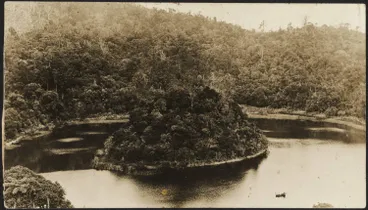
In late 1940s, Bill & Whina bought the 124-acre farm Tautoro from the Pākehā owner
William's twin brother, Eru, and his family came to live at Panguru on the Tautehere property Whina had bought in 1920s
Auckland Libraries

The Coopers campaigned for a district high school & Whina donated six acres of flat land at Panguru
The only school operating at Panguru was St Joseph's School
Auckland War Memorial Museum Tāmaki Paenga Hira
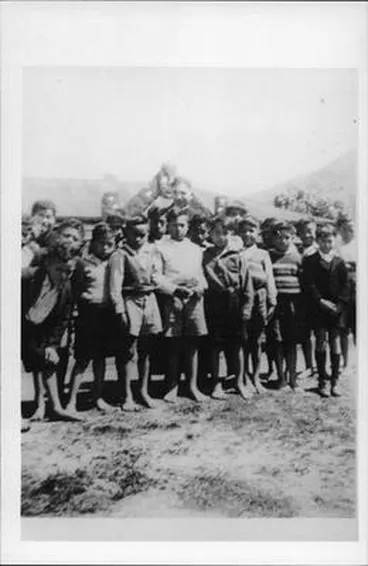
However, the Govt agreed to only build a single-room school in addition to still operating St Joseph's School
Auckland War Memorial Museum Tāmaki Paenga Hira
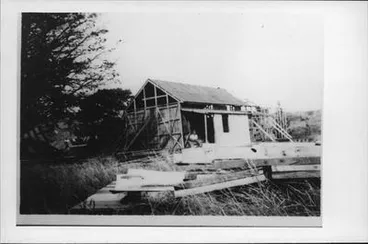
In August 1949, the community decided to relocate St Joseph's School onto the land donated by the Coopers
The school opened in 1950
Auckland War Memorial Museum Tāmaki Paenga Hira
8. Husband Bill Cooper died in Aug 1949 & Whina moved to Auckland
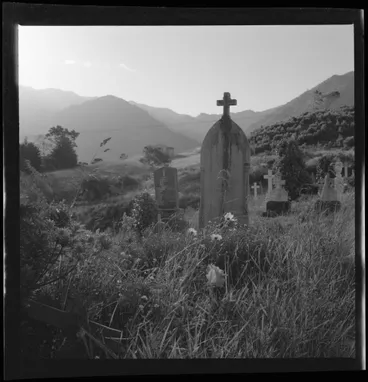
On 4 Aug 1949, when helping to relocate St Joseph's School, Whina's husband Bill Cooper had a heart attack & died
He was buried at Nāhareta urupa / cemetery. King Korokī later attended the unveiling of a memorial to Bill.
Museum of New Zealand Te Papa Tongarewa

Widowed Whina decided to move Auckland for her younger children's secondary education & sold her house
She had decided not to retain the house as the area was prone to flooding and sold it to the local storekeeper
Auckland War Memorial Museum Tāmaki Paenga Hira
9. Whina's national profile: 1950s to mid-1970s
Established Māori Women's Welfare League (MWWL) & appointed President, 1951-1957
"Mrs Cooper is a tremendous personality with few, if any, inhibitions and an “afraid of no one” complex. Of the many qualities which have brought her to the top the most conspicuous are those that single her out as a fighter—a fiery, hard hitting one too. She will not hesitate to demand when she judges that to be the most effective tactic, no matter how high or mighty be the person of whom she is demanding. She will relentlessly pursue her case till she gets satisfaction—there is no retreat. But she knows too that there are times when silence and meekness are golden. Her dynamic personality has been a wonderful asset, particularly in recent years when she has been one of the foremost in establishing and guiding the Maori Women's Welfare League."
Source: Papers Past: "Whina Cooper", Te Ao Hou (Sept 1955, p.17): https://paperspast.natlib.govt.nz/periodicals/TAH195509.2.17

1951: Whina established Māori Women’s Welfare League (MWWL) – Te Rōpū Wahine Māori Toko i te Ora
Motto was 'Tātau Tātau' – 'let us be united' to address own & family's needs. Patroness was Princess Te Puea Herangi.
Alexander Turnbull Library

In Sept 1951, MWWL's first national conference was held in Wellington during which Whina was elected as President
By March 1951, 160 branches & 14 district councils formed; & by Sept 1951, 187 branches with membership of 2503 women
Manatū Taonga, the Ministry for Culture and Heritage
After being elected President: "According to Dame Whina, she later returned to her home in Grey Lynn and knelt before a statue of the Virgin in her sitting room, chanting: "Please, e Maria, mau au e ako ki te korero. Kua oti au te poti e nga wahine o te motu, mau au e awhina" ("Please, Mary, tell me what to say. The women of the nation have made me leader, please help me ...")
Quoted in NZ Herald, 28 Sept 2001: "Maori women's long road to freedom"
1-3 April 1952: MWWL's annual conference held at Auckland & opened by Minister of Māori Affairs Ernest Corbett
Focal areas identified were housing, child welfare, health, education & employment; & arts & crafts (haka & weaving)
Alexander Turnbull Library
One of MWWL's first initiatives was a survey of Māori housing in Auckland in July 1952
Outcome was Auckland City Council & Dept of Māori Affairs improving quota of state and council housing for Māori tenants
Alexander Turnbull Library
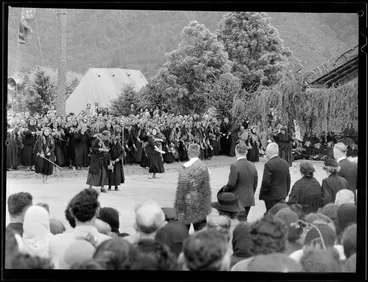
On 12 Oct 1952, Princess Te Puea died & tangi attended by Whina, PM Sidney Holland & Opposition leader Walter Nash
Govt officials also present: Min of Māori Affairs Ernest Corbett & MPs Hilda Ross & Iriaka Rātana
Auckland Libraries
On 21-23 April 1953: MWWL's conference was held in Wellington & Committees reported on social work & arts & crafts
Conference was opened by Minister of Māori Affairs Ernest Corbett
Alexander Turnbull Library
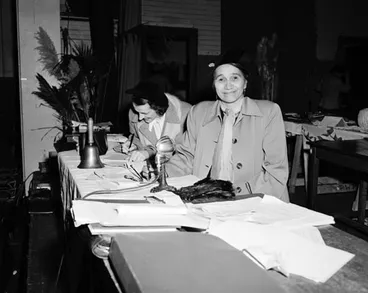
Whina's 1953 Presidential report included pressing problems on family life - lack of housing & consumption of liquor
Manatū Taonga, the Ministry for Culture and Heritage
As President of the Māori Women’s Welfare League (MWWL), Whina "established especially close relationships with National’s minister of Maori affairs, Ernest Corbett, and the leader of the opposition and Labour spokesman on Maori affairs, Walter Nash". Source: Michael King. 'Cooper, Whina', Dictionary of New Zealand Biography, first published in 2000. Te Ara - the Encyclopedia of New Zealand, https://teara.govt.nz/en/biographies/5c32/cooper-whina
For further information about MWWL over the years since its formation, see: NZ History: Te Rōpū Wāhine Māori Toko i te Ora Māori Women's Welfare League, https://nzhistory.govt.nz/women-together/maori-womens-welfare-league

1 June 1953: Whina Cooper received MBE Civil Division for services to the Māori
MBE (Member of the Order of the British Empire) was awarded in 1953 Coronation Honours list published in London Gazette
Auckland War Memorial Museum Tāmaki Paenga Hira

By mid-1950s, Whina involved with establishing over 300 MWWL branches, 88 district councils & 4000 members
Whina & members worked on Māori housing, child welfare, employment, education, and health issues
Auckland War Memorial Museum Tāmaki Paenga Hira
1950s: Whina was also President of Panguru Branch of Federated Farmers
Overseas inquiries tried to "trace any women holding down similar offices and none could be found". (Te Ao Hou)
Alexander Turnbull Library
1957: Whina retired as Māori Women's Welfare League President
Alexander Turnbull Library
In 1957, Whina selected as MWWL delegate for 1958 Pan Pacific & South East Asia Women's Assoc Conference in Ceylon
(Te Ao Hou article describes the work of women in Ceylon's villages.)
Alexander Turnbull Library
Whina involved in activities around Auckland, 1960s - 1974

In 1960s, Whina "worked on a local level around Auckland, but kept largely out of the national spotlight". (Wikipedia)
Image: Dame Whina Cooper photographed by Ans Westra during 1960s
Museum of New Zealand Te Papa Tongarewa
On 30 June 1962, Whina attended ordination of Rev. Henare Arekatera Tate of Panguru as the second Māori priest
Approx. 2000 Māori took part altogether in Tate's first mass & various functions in Auckland, including at Trades Hall
Alexander Turnbull Library

On 16 March 1963, Whina contested the by-election for Northern Māori electorate & lost to Matiu Rata of Labour Party
Whina stood as an Independent and came sixth, receiving 257 votes to Rata’s 3,090
Alexander Turnbull Library

In July 1963, Whina attended the Māori Women's Welfare League annual conference which was held in Rotorua
Photo taken by Ans Westra
Alexander Turnbull Library

In 1966, Whina attended the opening of Te Unga Waka Marae (Catholic marae & Māori Community Centre at Epsom)
Foyer plaque: "This place is the fruits of the efforts of the people, and of their Mother, Whina Cooper."
Auckland War Memorial Museum Tāmaki Paenga Hira

Whina had led two years of fundraising - concerts, raffles etc - for the Auckland Māori Catholic Society
Image: Contestant in the 'queen carnival' being run to raise money to complete Te Unga Waka
Auckland Libraries
1968: Whina organised a Waitangi Day pageant at Carlaw Park on the significance of the Treaty
Alexander Turnbull Library

1974: Women from Te Unga Waka joined others at a Māori Women's Conference held in Wellington
Alexander Turnbull Library

1974: Whina received CBE (Commander of the Order of the British Empire) for services to Māori welfare and culture
Whina was also a Justice of the Peace. See: https://www.thegazette.co.uk/ London/issue/46312/supplement/6830
Manatū Taonga, the Ministry for Culture and Heritage
10. Hikoi / Land march "Not one more acre of Māori land", 1975
‘Not one more acre of Māori land’ was the rallying call for the 1975 national hīkoi "Te Rōpū Matakite o Aotearoa" led by Whina Cooper. The hikoi departed from Te Hāpua in Te Tai Tokerau Northland on 14 September 1975 and arrived at Parliament in Wellington on 13 October 1975.
Ngāti Wai Action Committee invited Whina to lead land rights movement
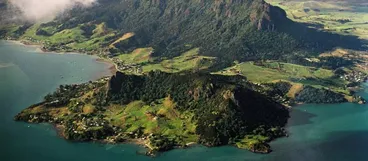
In 1975, Ngāti Wai iwi who occupy east coast between Whangarei & Whangaparoa formed the Ngāti Wai Action Committee
Manatū Taonga, the Ministry for Culture and Heritage
The Ngāti Wai Action Committee was set up to oppose acquisition of 4500 acres under Town and Country Planning Act 1953
The Crown's legislation required local Councils to create district planning schemes to zone & regulate all land use
National Library of New Zealand
The Committee also regarded the Māori Affairs Amendment Act 1967 as the "last land grab" by the Crown
Any Māori freehold land with four or fewer owners was compulsorily converted to "General Land" for public spaces
National Library of New Zealand
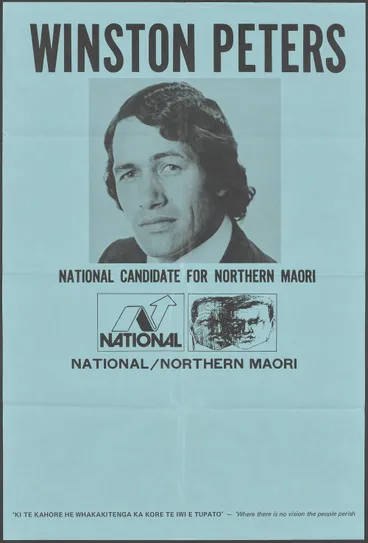
The legal adviser to the Committee was lawyer Winston Peters (b.1945 in Whāngarei) whose lineage included Ngāti Awa
(He intended to stand for National Party in Northern Māori electorate in Nov 1975, which Labour's Matiu Rata retained)
Hocken Collections - Uare Taoka o Hākena, University of Otago

The Ngāti Wai Action Committee approached Whina Cooper to lead a national campaign to change legislation
Whina also had links to Ngāti Wai through her first husband Richard Gilbert who was from Ngunguru
Auckland War Memorial Museum Tāmaki Paenga Hira
Whina named the land rights movement Te Rōpū o te Matakite
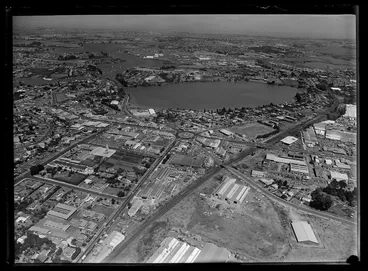
Whina was living with her son Joseph Cooper & family at Panmure, & began planning the land rights action with his help
Alexander Turnbull Library
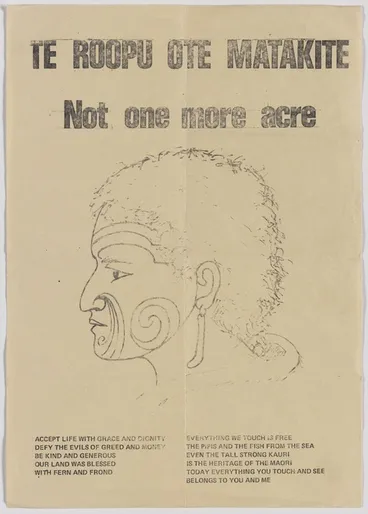
Whina decided on movement's name: Te Rōpū o te Matakite – "Those with Foresight "
The intent was “... to help the blind, to help those with no perception to see ahead the future.”
Alexander Turnbull Library
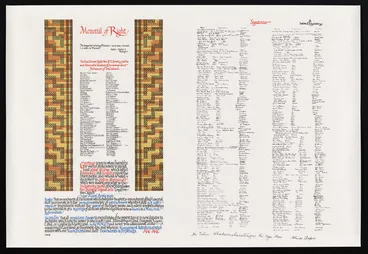
Joseph drafted the Memorial of Rights which asked the State to preserve the mana & Tūrangawaewae of the Māori people
As well as writing the text, Joseph also drew the graphic. (The document was later signed by 200 elders.)
Alexander Turnbull Library
Te Rōpū o te Matakite launched at hui convened by Whina on 1-2 March 1975
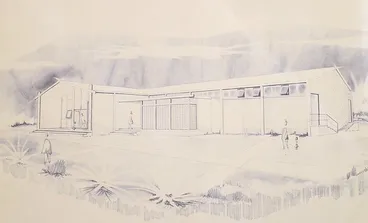
On 1-2 March 1975, Te Rōpū o te Matakite was launched at a hui convened by Whina in Mangere at Te Puea Marae
The hui agreed with Whina's proposal for a hikoi / march from Northland to present the Memorial of Rights to Parliament
Archives New Zealand Te Rua Mahara o te Kāwanatanga
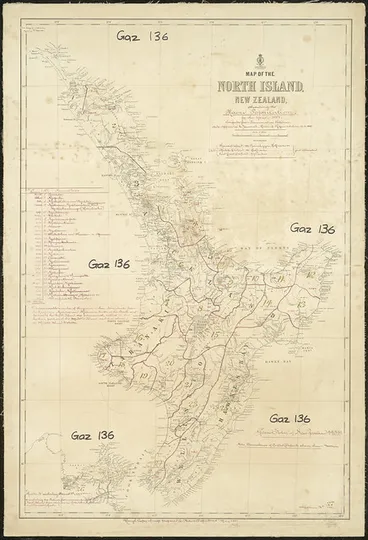
The hui was attended by iwi representatives, organisations & activists
Organisations included Kingitanga, the Māori Women's Welfare League, & Māori Organisation on Human Right (MOOHR)
Archives New Zealand Te Rua Mahara o te Kāwanatanga
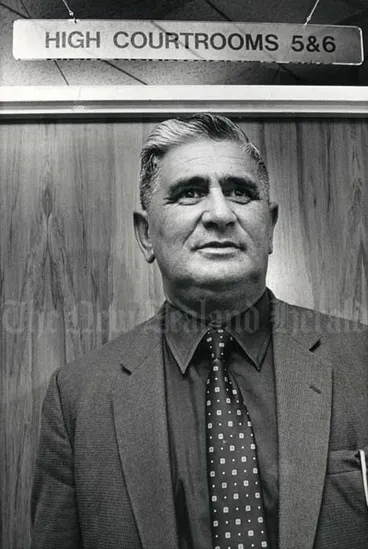
Graham Latimer attended in his capacity as President of the New Zealand Māori Council
Latimer had been elected President in 1973 after serving as Vice-President from 1969
Manatū Taonga, the Ministry for Culture and Heritage
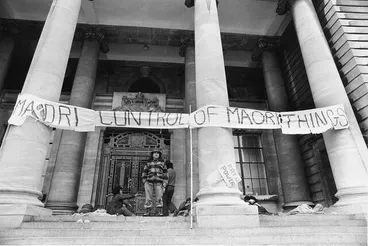
Activists included Ngā Tamatoa who'd formed at Univ of Auckland in 1970 to promote Māori rights & Treaty enforcement
Members included Hana & Syd Jackson, Titewhai Harawira & son Hone, & Tāme Iti
Christchurch Art Gallery Te Puna o Waiwhetū
Written brief 'Matakite Manifesto' sent by Dr Ranginui Walker, June 1975
A three-page written brief on legislation was sent to Whina and the Committee by Dr Ranginui Walker which became known as the 'Matakite Manifesto' . Dr Walker advised that following the Māori Affairs Amendment Act 1967, there had been submissions to Parliament by the New Zealand Māori Council, the Māori Women’s Welfare League, Māori Incorporations and other associations to bring about changes to the Act and slow down the alienation of Māori land. He pointed out that earlier statutes also led to the alienation of Māori land Ngāti Wai lands - the Rating Act 1925, the Town and Country Planning Act 1953, and the Counties Amendment Act 1961.
-
Dr Walker argued that it was “an act of cultural genocide” for the Pākehā to use his political power to keep fashioning laws “... that will eventually strip Māori of his tribal estate”. He concluded that, while our society was undeniably bi-cultural, its social and legal institutions are monocultural: “There is, for instance, no statute that recognises the cultural attitude of the Māori to land. There is no law that recognises communal ownership of land as a valid title equal in status to individual title. In the name of social justice, such legislation should now be written before it is too late ..."
Source: Vivian Hutchinson: Matakite: The 1975 Māori Land March: a 50th Anniversary Memoir, URL: https://www.taranaki.gen.nz/matakite50
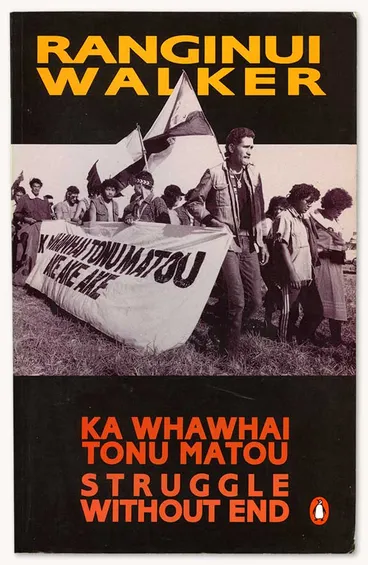
In June 1975, a brief on applicable leglslation written by Dr Ranginui Walker which became known as 'Matakite Manifesto'
Rating Act 1925, Town and Country Planning Act 1953, Counties Amendment Act 1961 & Māori Affairs Amendment Act 1967
Manatū Taonga, the Ministry for Culture and Heritage
Planning sessions held which decided date of Land March (15 Sept 1975) & route
The date of the Land March (15 Sept 1975) was Hana Jackson & Ngā Tamatoa's idea to coincide with Māori Language Week
(Audio interview with Hana on 15 Sept 1975: 5:14 mins)
Ngā Taonga Sound & Vision
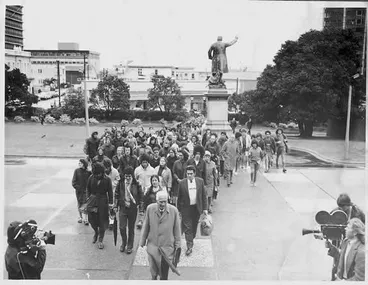
Ngā Tamatoa & Te Reo Māori Society were involved with Te Petihana Reo Māori (the Māori Language Petition) in Sept 1972
Outcome was creation of Māori Language Day on 14 Sept 1972 which was expanded to Māori Language Week in 1975
Manatū Taonga, the Ministry for Culture and Heritage

An itinerary for the Land March to present the Memorial of Rights to Parliament was prepared by Te Rōpū o te Matakite
Organiser contact names were Whina Cooper and Witi McMath. (Carmen Kirkwood was Whina's secretary.)
Archives New Zealand Te Rua Mahara o te Kāwanatanga

Route from Northland to Wellington was prepared for the Land March which incorporated stopping overnight at marae
(When the marchers stopped overnight at different marae, Whina to lead discussions about the purpose of the march)
Archives New Zealand Te Rua Mahara o te Kāwanatanga

Co-organisers included Witi McMath & Tama Poata (see image), Titewhai Harawira & Joseph Parata
Alexander Turnbull Library
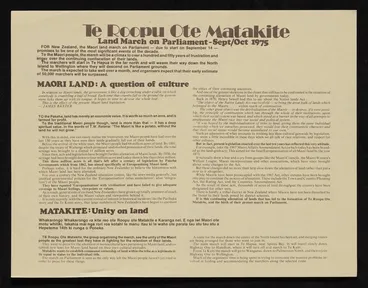
To promote the Land March, a flyer was written which was also published in the Auckland newspaper 'City News' in June
Text was written by journalist & activist Vivian Hutchinson who also worked for the City News
Alexander Turnbull Library

A booklet was also issued by Te Rōpū o te Matakite explaining "Why we march"
Contact name was Mrs Titiwhae Harawira whose address & phone number were given
Manatū Taonga, the Ministry for Culture and Heritage

A Petition was prepared to gather signatures (names & addresses) during the Land March
Manatū Taonga, the Ministry for Culture and Heritage

Ministry of Transport arranged for Chief Traffic Offficers in Districts to liaise with Land March representatives
Letter (17 Sept 1975) from Ministry of Transport to Minister of Māori and Island Affairs
Archives New Zealand Te Rua Mahara o te Kāwanatanga

Discussions were also held between the Police and Land March organisers on safety issues
Letter (23 Sept) from Min. of Police to Min. of Māori Affairs set out Police safety measures & medical aid for marchers
Archives New Zealand Te Rua Mahara o te Kāwanatanga

23 Aug 1975: Article "Final Battle Ahead" by Pauline Ray published in Listener (v.79: n.1864: p.18-19)
The photo of Whina which appeared alongside the article was taken by Robin Morrison in June 1975 for the NZ Listener
Auckland War Memorial Museum Tāmaki Paenga Hira
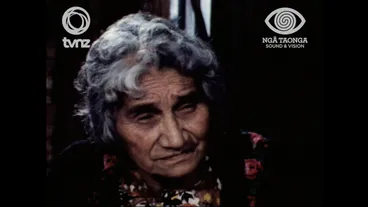
25 Aug 1975: Documentary "Encounter - This land is ours" (27:35 mins) screened on TV2 before the Land March
Includes speeches by Whina & footage of her leading Matakite supporters on a bus trip from Auckland to Kaikohe
Ngā Taonga Sound & Vision
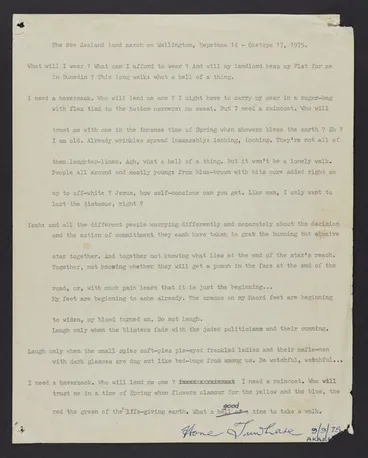
On 9 Sept 1975, the poem 'The New Zealand Land March on Wellington' was written by Hone Tuwhare who joined the march
Alexander Turnbull Library
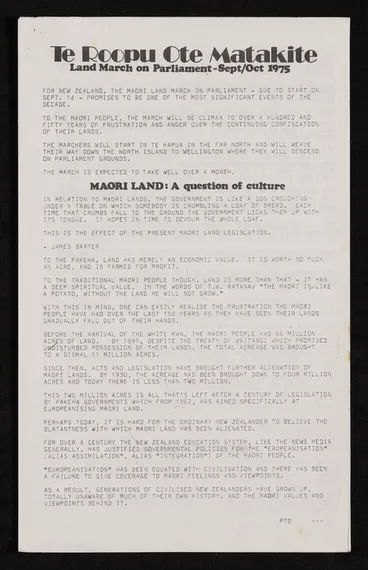
c.Sept 1975: Three page leaflet on the Land March created by Te Ropu Ote Matakite
Includes information on hīkoi background, guidelines, & North Island itinerary
Alexander Turnbull Library
Whina & 50 marchers set off from Te Hāpua in the Far North on Sunday 14 Sept 1975
Images of the land march were captured by Christian Heinegg, John Miller, Ans Westra, and press photographers, amongst others. An online exhibition Ngā Tapuwae o te Hīkoi features photographs, archival records and stories from the 1975 Māori Land March, as well as the Māori rights movement of the 1970s. See: Ngā tapuwae o te hīkoi | National Library of New Zealand
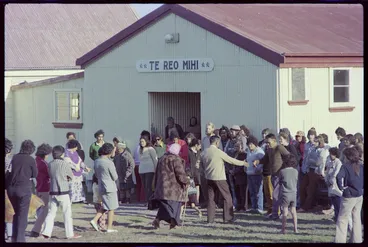
On 13 Sep 1975, Whina & marchers gathered at Te Reo Mihi wharenui at Te Hiku o te Ika Marae, Te Hāpua in the Far North
Alexander Turnbull Library

They stayed overnight at Te Hāpua in readiness to set off on the march the next day
Photo shows them bedded down inside Te Reo Mihi wharenui
Manatū Taonga, the Ministry for Culture and Heritage

On Sunday 14 Sept 1975, Whina & 50 marchers set off from Te Hāpua on the 1,100km hikoi to Parliament in Wellington
NZ On Screen
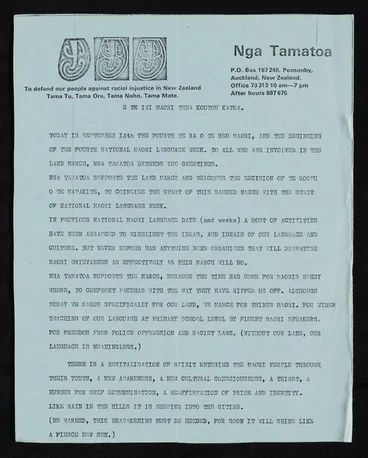
In a flyer dated 14 Sept 1975, Ngā Tamatoa wrote of its support for the Land March starting in Māori Language Week
Alexander Turnbull Library

At instructions of Whina there were no placards or banners, just a white flag on a carved pou whenua or land marker pole
Alexander Turnbull Library
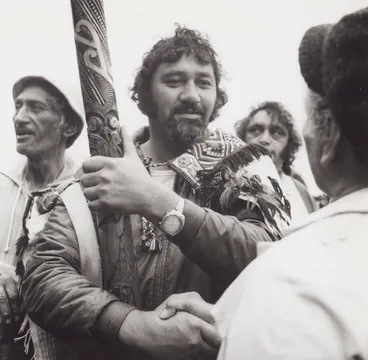
Close-up image of the carving on the pou whenua
The pou whenua was carved by Moka Puru who'd married Whina's daughter Hinerangi
Museum of New Zealand Te Papa Tongarewa
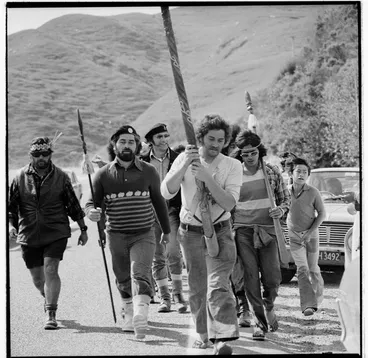
The pou whenua was not allowed to touch the ground until land grievances were settled
Alexander Turnbull Library

Excerpt from TVNZ film showing Whina walking with marchers (39 secs)
(Audio of one of the marchers explaining his reasons for taking part.)
Manatū Taonga, the Ministry for Culture and Heritage

Whina & co-organisers photographed catching up with the news during the first day of the march
Alexander Turnbull Library

17 Sept 1975: Being greeted on arrival at Ōtiria Marae
At each marae, Whina led discussions about the purpose of the hikoi & encouraged others to join in
Alexander Turnbull Library

c.17-18 Sept 1975: Poet Hone Tuwhare during a stop on the Land March between Ōtiria & Hikurangi
Alexander Turnbull Library

c.18-19 Sept 1975: Schoolchildren watch the marchers pass by
Alexander Turnbull Library

Numbers increased as the marchers neared Auckland Harbour Bridge, & vehicles became allowed as more elderly also joined
The hikoi was supposed to be on foot, but as more elderly people were joining the organisers allowed vehicles
National Library of New Zealand
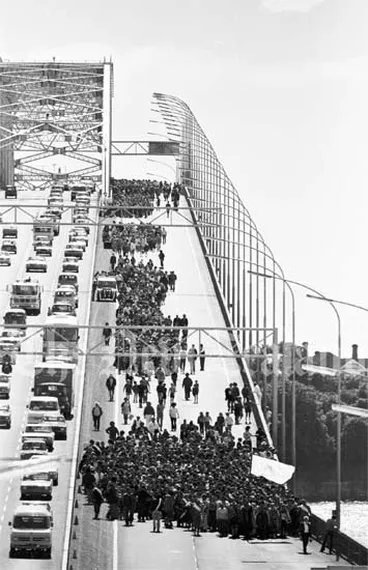
Marchers trained with the military before crossing the Harbour Bridge - one step in front of the other to avoid sway
Manatū Taonga, the Ministry for Culture and Heritage

On 23 Sept 1975, Whina & the marchers crossed the Auckland Harbour Bridge
Pakeha also joined Maori to participate in the hikoi
Alexander Turnbull Library
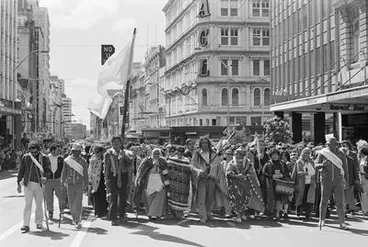
Marching down Queen Street, Auckland
Auckland War Memorial Museum Tāmaki Paenga Hira

Passing through College Hill, Auckland
On the left in the red tracksuit is Whina's son-in-law Moka Puru who carved the pou which is being carried by Joe Hawke
Alexander Turnbull Library

View of Whina in car during the hikoi through Auckland
Alexander Turnbull Library
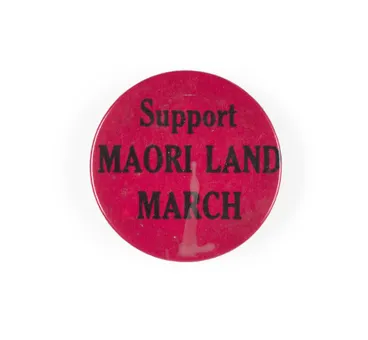
The badge "Support Maori Land March" was distributed & worn by activists, supporters, trade unionists & NZUS, etc
This badge belonged to activist Rona Bailey (1914-2005)
Museum of New Zealand Te Papa Tongarewa
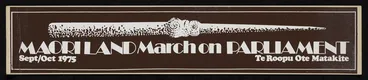
Sticker showing an illustration of a tokotoko (carved walking stick) was designed by Vivian Hutchinson
sticker reads: "Maori Land March on Parliament, Sept/Oct 1975, Te Roopu Ote Matakite"
Alexander Turnbull Library


26 Sept 1975: Māori Land March along Victoria Street in Hamilton
Tame Iti carrying the pou whenua, accompanied by Whina Cooper, Moka Puru, and others
Alexander Turnbull Library

Whina Cooper addressing Māori Land March at Hamilton
Alexander Turnbull Library
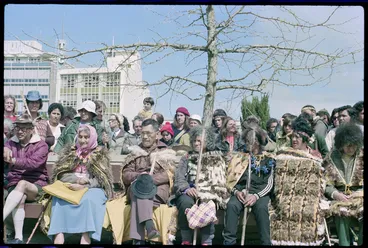
Whina Cooper and kaumatua seated while Tame Iti speaks at Hamilton
Alexander Turnbull Library
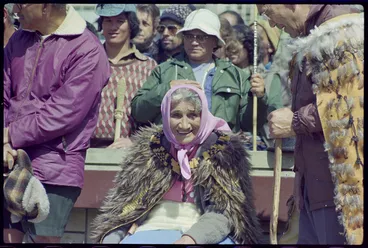
Close-up of Whina wearing kahu huruhuru at Hamilton
Alexander Turnbull Library

28 Sept 1975: Washing during a rest day at Te Kūiti Pā
Alexander Turnbull Library

30 Sept 1975: Women at Otoko Marae (40 kms north of Whanganui) prepare meal for the marchers who'd be staying overnight
Alexander Turnbull Library

1 Oct 1975: Marchers gathered outside Tauakira meeting-house at Otoko Marae
The march stopped at 25 marae, gathering signatures for a Memorial of Rights
Alexander Turnbull Library


3 Oct 1975: Arriving outside the temple at Rātana Pā which lies south-east of Whanganui
Alexander Turnbull Library
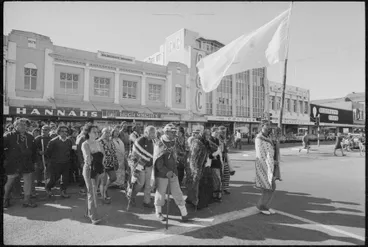
6 Oct 1975: Turning from Broadway and heading towards the Post Office entrance to the Square at Palmerston North
They were greeted with prayers, hymns & welcoming speeches by locals & Rangitane Māori Committee patron Robert Governor
Palmerston North City Library
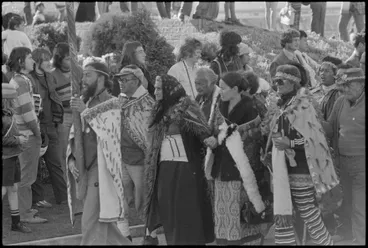
Arrival at the Square in Palmerston North draws spectators
Palmerston North City Library
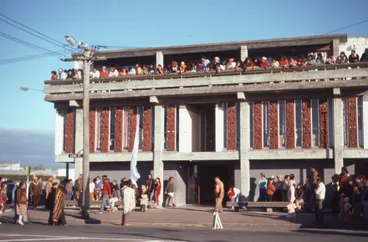
Hīkoi welcomed by a large crowd at Te Rau Aroha Māori Battalion Hall in Palmerston North
Palmerston North City Library

Staying overnight at Te Rau o Te Aroha Māori Battalion Hall
Alexander Turnbull Library

8 Oct 1975: Food table set out in a tent at Poutu Marae, Shannon
Alexander Turnbull Library
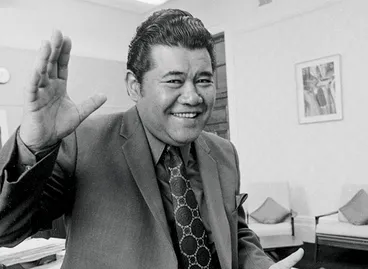
Meanwhile, on 10 Oct 1975, the Waitangi Tribunal was created by Labour MP Matiu Rata through Treaty of Waitangi Act 1975
As Min. of Māori Affairs, Rata agitated for Tribunal to investigate Crown actions inconsistent with Treaty principles
Manatū Taonga, the Ministry for Culture and Heritage

11 Oct 1975: Whina speaking on Takapuwahia Marae, Porirua
Alexander Turnbull Library
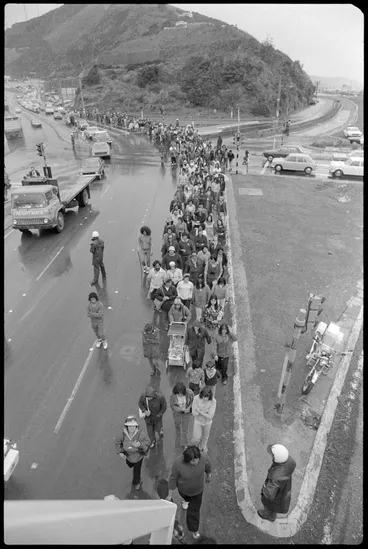
The marchers turned into the Hutt motorway from the Ngauranga Gorge
It took an 1.5 hours to complete the Porirua-Wellington motorway stage
Palmerston North City Library

Māori land march nearing its destination in Wellington
Manatū Taonga, the Ministry for Culture and Heritage
Hikoi with c.5000 arrive at Parliament, Wellington on Monday 13 October 1975

On Mon 13 Oct 1975, hikoi with up to 5000 people arrived at Parliament after marching 1,100 kms throughout the North Is
Manatū Taonga, the Ministry for Culture and Heritage

Aerial view of the Māori Land March crowd at Parliament grounds
Alexander Turnbull Library
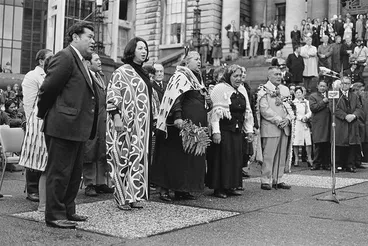
Parliamentary welcome
L-R: Matiu Rata, Whetū Tirikātene-Sullivan, Hārata Ria Te Uira Solomon, Sally Marshall & Tarawara Kātene
Christchurch Art Gallery Te Puna o Waiwhetū
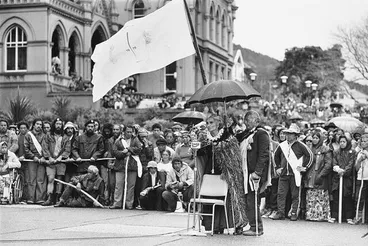
Whina Cooper speaking at the Parliamentary welcome
Christchurch Art Gallery Te Puna o Waiwhetū
Whai Ngata's recording of the speeches made outside Parliament (31:03 mins)
Ngā Taonga Sound & Vision

Whina presented the Memorial of Rights & petition to Labour PM Bill Rowling & National Party leader Rob Muldoon
Manatū Taonga, the Ministry for Culture and Heritage

The Memorial of Rights was signed by 200 Māori elders & the Petition sheet was signed by 60,000 people
Image of the Petition & the satchel in which it was carried to Parliament
Manatū Taonga, the Ministry for Culture and Heritage
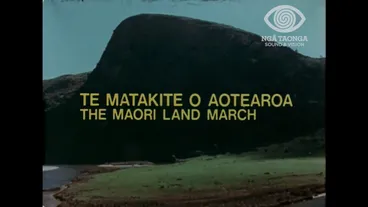
TV2 documentary (1975): "Te Matakite o Aotearoa - The Māori Land March" directed by Geoff Steven (1 hr 2:03 mins)
Covers the hikoi from Te Hāpua in the Far North to Parliament in Wellington
Ngā Taonga Sound & Vision
After the Parliamentary greeting, Whina returned home to await Govt's outcome
After presenting the Memorial of Rights and Petition at the Parliamentary reception, Whina returned home to await the outcome from the Government.
The following information was published in the Press on 18 October 1975 about what had taken place during the Parliamentary reception and Whina's intentions afterwards:
Mrs Cooper presented an ornate document to Mr Rowling. It was said to have been signed by 60,000 people. It called for an end to all legislation which “alienated” Maori land and the repeal of all laws which did so. Mr Rowling said he would pass it on to the Speaker of the House, and spoke about how sympathetic the Government was to the Maori land question — in effect echoing the words of Mr Muldoon and Mr Rata.
Mrs Cooper has said she is giving the Government a period of grace to implement the wishes of the marchers. She said that if nothing concrete occurred she would return her C.B.E, and M.B.E. to the Queen and take all her followers back to Parliament to camp until something did happen. Watch-dog committees of Te Roopu O Te Matakite are also being set up to keep an eye on things.
Source: Papers Past: Paul Ransley (18 Oct 1975), "The Maori march: did it achieve anything?" (Vol. CXV, Issue 33977, p.9): Papers Past | Newspapers | Press | 18 October 1975 | The Maori march: did it achieve anything?
Two-month occupation of Parliament grounds led by Titewhaia Harawira

Mrs Titewhaia Harawira & members of Ngā Tamatoa decided to stay on in Wellington to have a sit-in on Parliament grounds
(Image: Titewhai Harawira leading the protesters in song at Parliament on 22 Oct 1975.)
Alexander Turnbull Library
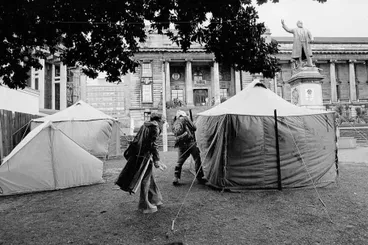
A 'Māori Embassy' was set up in tents by c.60 protesters to maintain pressure on the Govt which lasted 2 months
Activist Tame Iti & others had been inspired by the Aboriginal Tent Embassy established in Canberra in 1972
Manatū Taonga, the Ministry for Culture and Heritage

Whina publicly distanced herself from the 'Embassy' as she felt this desecrated the "sacredness" & dignity of the hīkoi
Museum of New Zealand Te Papa Tongarewa
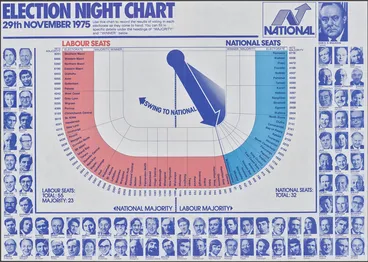
On 29 Nov 1975, Rob Muldoon's National Party defeated Bill Rowling's incumbent Labour Party at the polls
It was the first general election where 18-20 year olds & all permanent residents were also eligible to vote
Hocken Collections - Uare Taoka o Hākena, University of Otago
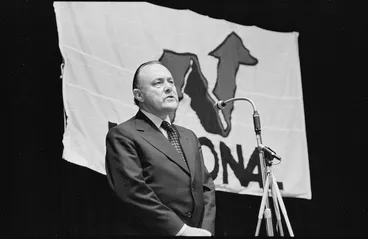
Whina sent a telegram to incoming National Party PM Rob Muldoon saying the splinter group had no mandate from her group
Alexander Turnbull Library
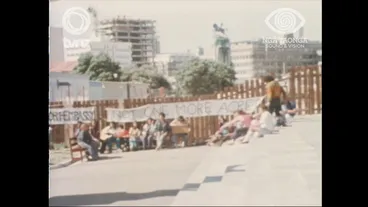
On 24 Dec 1975, the protesters were evicted by the police & the 'Māori Embassy' tents dismantled. (See film: 6:35 mins)
Ngā Taonga Sound & Vision
After National Party wins Nov election, Whina & delegation hold talks, Jan 1976
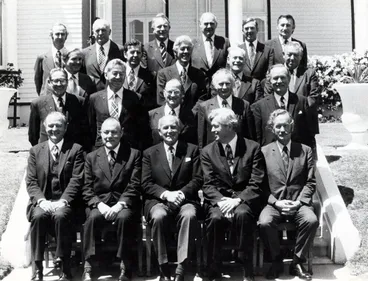
The National Government's Cabinet Ministers included Duncan MacIntyre who was appointed Minister of Māori Affairs
(Winston Peters was unsuccessful for National in Northern Māori electorate which was retained by Labour's Matiu Rata.)
Wellington City Libraries

On 12 Feb 1976, Te Rōpū o te Matakite Aotearoa delegation held talks on Māori land issues with new National Govt
Meeting included PM Rob Muldoon & Min. of Māori Affairs Duncan MacIntyre in Parliament's Māori Affairs Committee Room
Alexander Turnbull Library

As the meeting did not lead to immediate legislative halts to all land sales, other land protests escalated
Protests included Raglan Golf Course campaign with Eva Rickard & Bastion Point occupation led by Joe Hawke
Auckland War Memorial Museum Tāmaki Paenga Hira
11. Events when Whina still living in Auckland: 1977 - 1983

During 1977, Whina visited the camp at Bastion Point in Orakei occupied since 5 Jan 1977 by protesters led by Joe Hawke
Ngāti Whātua opposed Govt's plans to develop housing on the land & were evicted with 222 arrested on 25 Jan 1978
Auckland War Memorial Museum Tāmaki Paenga Hira
In Aug 1978, Whina shared her work with the Māori Women's Welfare League during interview with Alwyn Owen (4 min 22 sec)
Excerpt from "Herea Te Tangata Ki Te Whenua - Bind the people to the land) broadcast on RNZ Spectrum: 24 & 31 Aug 1978
Manatū Taonga, the Ministry for Culture and Heritage
1978: Audio of Dame Whina talking about her Christian faith and the Land March (15:26 mins)
Audio is an excerpt from radio documentary programmes Spectrum 280 & 281 by Alwyn Owen
Ngā Taonga Sound & Vision

Prime Minister Robert Muldoon became a great friend of Dame Whina
Whina often stayed with Muldoon's family at their Hatfield Beach bach near Orewa, & they shared a love of gardening
Auckland War Memorial Museum Tāmaki Paenga Hira

1981: New Year Honours - Whina was promoted to DBE ( Dame Commander of the Order of the British Empire)
See: https://gazette.howison.co.nz/nzg/1981/issue/2/page/73
Museum of New Zealand Te Papa Tongarewa
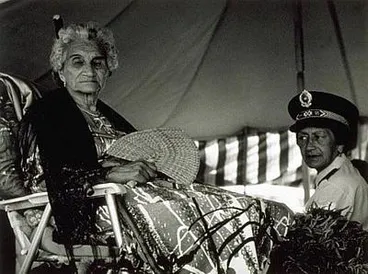
6 Feb 1981: Dame Whina Cooper at Te Tii Marae, Waitangi at the time of her investiture on Waitangi Day
See: https://www.thegazette.co.uk/ London/issue/48469/supplement/39
Auckland Art Gallery Toi o Tāmaki

Wore "raukura" (clusters of feathers worn as hair ornaments)
Alexander Turnbull Library

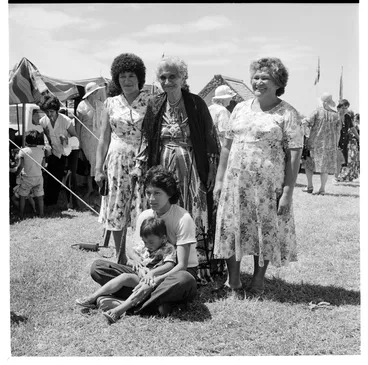
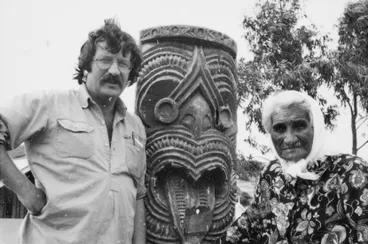
During 19 April 1982 - 3 Feb 1983, Michael King met with Dame Whina Cooper to gather material for her biography
The recorded interviews are held by Alexander Turnbull Library. "Whina: A Biography of Whina Cooper" was published 1983.
Manatū Taonga, the Ministry for Culture and Heritage
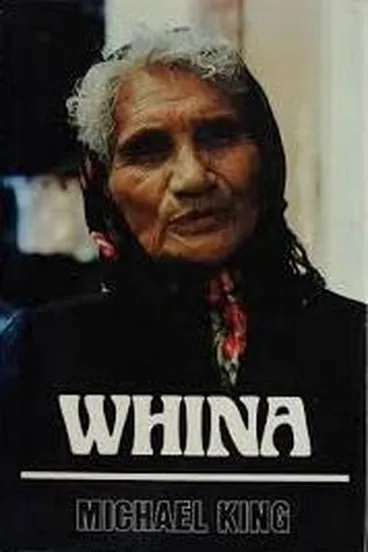
Michael King's "Whina: A biography of Whina Cooper" was published by Hodder & Stoughton
Auckland War Memorial Museum Tāmaki Paenga Hira

19 Nov 1983: Whina at the book launch of her biography which was held at the Auckland Museum
Event was held in the Māori Hall (now Te Marae Ātea Māori Court) & Ngāpuhi leader Sir James Henare was the guest speaker
Auckland War Memorial Museum Tāmaki Paenga Hira
12. Home to Panguru & events attended: 1983-1994

In 1983, Whina returned to Panguru to live in a home built by her grandfather down the road from former family homestead
She was interviewed at Panguru during 1983. See: Koha- Whina Cooper (NZ On Screen interview, Part One)
NZ On Screen

4 Feb 1984: Speaking at Waitangi
Auckland War Memorial Museum Tāmaki Paenga Hira
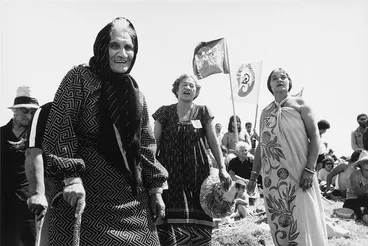
1985: Whina Cooper, Eva Rickard and Titewhai Harawira at Waitangi
Christchurch Art Gallery Te Puna o Waiwhetū

Speaking at Waitangi in 1985
Auckland War Memorial Museum Tāmaki Paenga Hira

Whina Cooper at Waitangi
Auckland War Memorial Museum Tāmaki Paenga Hira

Whina Cooper at Waitangi
Auckland War Memorial Museum Tāmaki Paenga Hira

April 1987: With family and friends at the Polynesian Festival at Tamaki College
Auckland Libraries
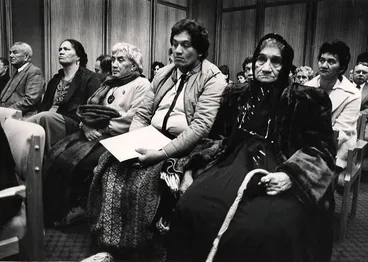
5 May 1987: Attended Court of Appeal in Wellington to witness Māori Council v Attorney-General over land transfers
Outcome: Crown to pay heed to previous Māori ownership & Treaty principles when wanting to transfer land to SOEs
Manatū Taonga, the Ministry for Culture and Heritage
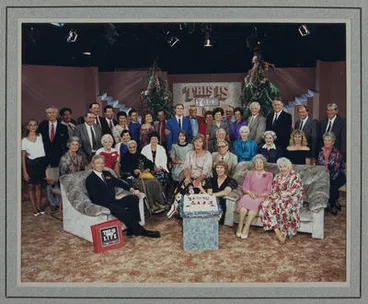
On 30 Sept 1987: NZ TV series "This is your life" hosted by Bob Parker celebrated Dame Whina Cooper
Auckland War Memorial Museum Tāmaki Paenga Hira

22 Nov 1987: Whina present during Pope John Paul's visit to Auckland Domain
Auckland War Memorial Museum Tāmaki Paenga Hira
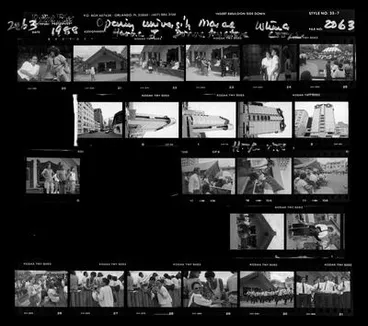
19 Feb 1988: Whina speaks at the opening ceremony of Auckland University Marae
Auckland University Marae, Tane-nui-a-Rangi, Waipapa
Auckland War Memorial Museum Tāmaki Paenga Hira

Whina during the opening ceremony
Photo by Gil Hanly
Auckland War Memorial Museum Tāmaki Paenga Hira
1988: Whina spoke at a Parliamentary event on the future of the Dpt of Māori Affairs (1:30 mins)
Govt's April 1988 policy green paper 'He Tirohanga Rangapū' (Partnership Perspectives) had proposed devolution & closure
Alexander Turnbull Library

Jan 1990: Whina opened 14th Commonwealth Games in Auckland
Whina meets young people of the Commonwealth at the Te Puea Memorial Marae, Mangere
Auckland Libraries

Whina's message: "‘Let us all remember that the Treaty was signed so that we could all live as one nation in Aotearoa"
NZ On Screen

1990: Whina received the New Zealand Commemoration Medal o celebrate the 150th anniversary of the signing of the Treaty
Also known as the Sesquicentennial Medal Medal, it was awarded to 3,632 people
Auckland War Memorial Museum Tāmaki Paenga Hira

1 July 1991: In the Queen's Birthday Honours, Whina became twentieth appointee to the Order of New Zealand (ONZ)
NZ's highest civil honour. See: https://gazette.howison.co.nz/nzg/1991/issue/98/page/2191
Manatū Taonga, the Ministry for Culture and Heritage

Sept 1993: Whina was awarded the New Zealand Suffrage Centennial Medal
Awarded to: "Dame Whina COOPER, ONZ, DBE, JP, of Hokianga"
Auckland War Memorial Museum Tāmaki Paenga Hira

20 Sept 1993: At Māori Women's Welfare League book launch for Te Tiratanga Tatau Tatau, Alexandra Park
Auckland War Memorial Museum Tāmaki Paenga Hira
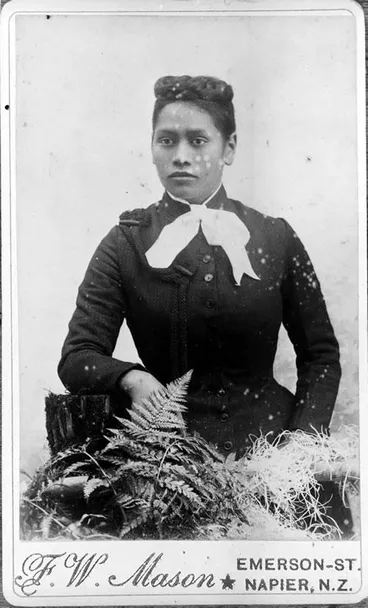
1994: Whina organised a memorial stone for suffragist Meri Te Tai Mangakāhia at her north Hokianga birthplace
(In May 1893, Meri addressed Māori Parliament - Māori women be given the vote & be eligible to sit in Māori Parliament)
Manatū Taonga, the Ministry for Culture and Heritage
13. Dame Whina Cooper died at Panguru on 26 March 1994

26 March 1994: Dame Whina Cooper died at Panguru aged 98 & was buried in the Nahareta Urupā (cemetery) above Waipuna
Her tangihanga (funeral) was attended by 'many thousands' estimated at 30,000 & viewed by over a million on TV
Whangarei Libraries
14. Ongoing land issues in Far North/Tai Tokerau involving Whina's family
On 28 Oct 2012, Te Rarawa & Crown signed Far North iwi Deed of Settlement which Whina's son Joe said realised her dream
The deal worth up to $70m included two former Landcorp farms, Crown forest land, & cash transfer of $33m
Radio New Zealand
Hikoi planned for 11 June 2021 against Far North District Council's plans to reclassify significant natural areas (SNAs)
On receiving negative feedback, the Council had decided to pause its SNAs plans, but community wanted it scrapped
Radio New Zealand
Whina's daughter Hinerangi (aged 84) & c.1500 joined the hīkoi to present petition to Councll's offices in Kaikohe
Petition calling for the Council to stop, rather than pause SNAs was presented to FNDC councillor Moko Tepania
Radio New Zealand
On 12 June 2021. RNZ reported the Deputy Prime Minister Grant Robertson supported the call for a rethink on SNAs
Outcome was Govt suspended SNAs until Resource Management Act 1991 updated
Radio New Zealand
On 9 March 2023, a Waitangi Tribunal draft stage 2 report for Northland Treaty claims was handed over at Waitangi
Report's recommendations included the Crown to apologise to Te Raki [Northern] Māori & return Crown-owned land
Radio New Zealand
22 Sept 2026: Resource Management Act to be replaced with Planning Act & Natural Environment Act
The Bills for the two new Acts passed 3rd reading on 22 Sept & were to receive their Royal Assent to become law
Radio New Zealand
15. Commemorations
'Famous New Zealanders' postage stamp, 4 Oct 1995
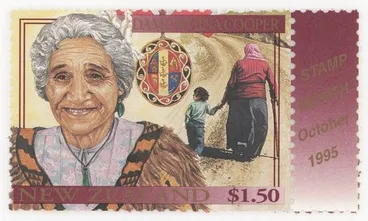
4 Oct 1995: $1.50 'Famous New Zealanders' postage stamp designed by Karen Odiam & issued by the NZ Post Office
'Famous New Zealanders' was a six-stamp collection featuring prominent community leaders & social campaigners
Museum of New Zealand Te Papa Tongarewa
Bronze statute unveiled at Pangaru's Waipuna Marae, 3 Feb 2020
A bronze statue commemorating Dame Whina Cooper was unveiled at Pangaru's Waipuna Marae on 3 February 2020. The memorial was unveiled by her son Joe Cooper and then-Prime Minister Jacinda Ardern. The statue recreates the iconic photo of Dame Whina walking hand in hand with her mokopuna / granddaughter, Irenee Cooper, at the start of the Land March in 1975. It was sculptured by Jimi Hills of Ngāti Porou, Tūhoe and Te Whānau a Upokorehe.
Radio New Zealand (RNZ) reported, "Prime Minister Jacinda Ardern spoke on the pae, a decision carefully thought through by the kaumātua at Waipuna marae. Te Rarawa leader Haami Piripi said it was only fitting for a wāhine to stand. "It was something that we thought long and hard about and decided that it was appropriate ... following in Whina's footsteps, it would certainly be appropriate. We have to reexamine our own tikanga. We have to progress with the times."

3 Feb 2020: Statue Of Dame Whina unveiled at Waipuna Marae, Panguru
Youtube video of unveiling of statue sculptured by Jimi Hills of Ngāti Porou, Tūhoe and Te Whānau a Upokorehe
Radio New Zealand
Dame Whina Cooper Tunnel Boring Machine unveiled 4 Dec 2020
In March 2020, City Rail Link (CRL) opened poll to name Auckland central tunnel boring machine after inspirational woman
Poll: Dame Whina Cooper, Antarctic scientist Dr Margaret Bradshaw & Georgina Beyer (World's 1st transgender Mayor & MP)
Radio New Zealand

4 Dec 2020: CRL's tunnel boring machine named after pollster winner Dame Whina Cooper was unveiled
(Machine to drill twin 3.45km tunnels between Waitematā & Maungawhau Stations, which later opened on 11 Sept 2026)
Radio New Zealand

At unveiling, meaning behind the naming was shared by CRL's Chief Executive & intent to forge relationships with Māori
Whina's family had given permission to use her name & daughter Hinerangi spoke about her mother & the tunnelling project
The Spinoff
Dame Whina's clothing collection launched by Irenee Cooper, 9 Dec 2024
On 9 Dec 2024, the first phase of a collection of Dame Whina's clothing was launched on date of her birthday
See RNZ article on interview with granddaughter Irenee Cooper on the purpose of the clothing collection (8 Dec 2024)
Radio New Zealand
16. Further resources include:
Documentaries / Films:
Also see: Māori Tube: Whina Cooper – Te Whaea o te Motu (1992) – Documentary
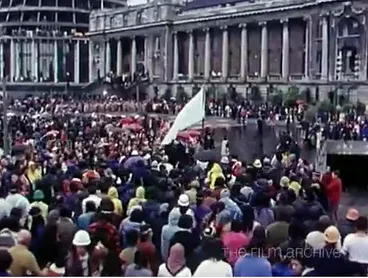
1975: Te Roopu o te Matakite march on Parliament
Te Rōpū Matakite o Aotearoa march to Parliament, 1975
Manatū Taonga, the Ministry for Culture and Heritage

1983: Koha - Whina Cooper (NZ On Screen interview in two parts)
Koha - Whina Cooper (part two)
NZ On Screen

1983: Gary McCormick travels in Hokianga includes an interview with Dame Whina Cooper
Heartland - Hokianga
NZ On Screen
Radio / audio interviews:
24 Aug 1978 (Part 1): RNZ Spectrum: Whina discusses with Alwyn Owen her life & work with Māori Women's Welfare League
Spectrum: Whina Cooper 1978 - Part 1 of 2
Radio New Zealand
31 Aug 1978 (Part 2) of Whina's discussion with Owen ("Herea Te Tangata Ki Te Whenua - Bind the people to the land")
Spectrum: Whina Cooper 1978 - Part 2 of 2
Radio New Zealand
19 Apr 1982: Dame Whina Cooper interviewed by Michael King
Interview with Whina Cooper, tape one
Alexander Turnbull Library
6 March 1986: Sir James Henare interviewed by Michael King about Dame Whina Cooper
Interview with Sir James Henare, tape one
Alexander Turnbull Library
2015: Panellists Cyril Chapman, Vivian Hutchinson & David Williams reflect on their involvement in the land march
1975 Land March - Commemorating 40 years
Radio New Zealand
2016: RadioNZ article "Not one more acre" - Northland kuia Titewhai Harawira interviewed about Whina and the land march
'Not one more acre'
Radio New Zealand
2017: Interview with author Hannah Jewell whose book includes Dame Whina Cooper
Hannah Jewell: 100 nasty women of history
Radio New Zealand
2018: Interview with Haami Piripi who participated in the hikoi as a teen
'Not one more acre': The mana of Dame Whina Cooper
Radio New Zealand
Books & Articles:
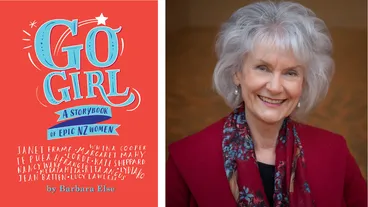
1978: "Go Girl: A Storybook of Epic NZ Women" by Barbara Else, which includes Dame Whina Cooper
Why Go Girl needed to be written - The Sapling
The Sapling

1987: Written by Michael King & published by New Zealand. Department of Education, School Publications Branch
Whina Cooper : teachers' notes
Auckland War Memorial Museum Tāmaki Paenga Hira
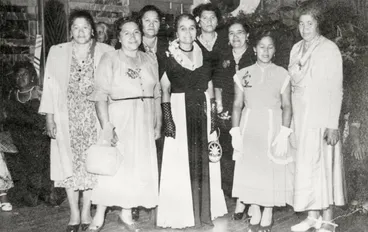
1987: "Women: Today & yesterday" by Florence Keene. (Biographies of 34 women who live or lived in Northland.)
Panguru Group Photograph
Whangarei Libraries

Te Ara - Dictionary of New Zealand biography provides information (compiled in 2000)
Whina Cooper
Manatū Taonga, the Ministry for Culture and Heritage

2003: Published in 'Harpies & Heroines' book by the New Zealand Cartoon Archive
Webb, Murray, 1947- :[Caricature portrait of Dame Whina Cooper. 1980-90s].
Alexander Turnbull Library

2004: "Hīkoi: Forty Years of Māori Protest" by Aroha Harris
Hikoi : forty years of Maori protest
Auckland War Memorial Museum Tāmaki Paenga Hira

2011: Dame Whina Cooper is one of the 50 Kiwis listed in Maria Gill's book
New Zealand hall of fame : 50 remarkable kiwis
Auckland War Memorial Museum Tāmaki Paenga Hira


2021: Includes Dame Whina Cooper
Kia kaha : a storybook of Maori who changed the world
Auckland War Memorial Museum Tāmaki Paenga Hira
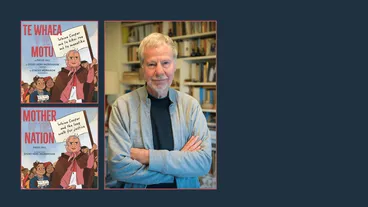
2025: Picture book "Mother of the Nation: Whina Cooper and the Long Walk for Justice" by David Hill (See Interview)
Interview: David Hill on Mother of the Nation - The Sapling
The Sapling
2025: "Matakite: the 1975 Māori land march : a 50th anniversary memoir" by Vivian Hutchinson
Matakite : the 1975 Māori land march : a 50th anniversary memoir / by Vivian Hutchinson.
National Library of New Zealand
Papers Past: Articles in digitised early NZ newspapers (19th & 20th C.), magazines & Parliamentary Papers etc
Papers Past
Manatū Taonga, the Ministry for Culture and Heritage

Poetry
1978: Poem "Rain-maker’s song for Whina" by Hone Tuwhare, published in "Making a fist of it." (Dunedin: Jackstraw Press)
Manatū Taonga, the Ministry for Culture and Heritage
2015: Search engine Google marked 120th birthday of Whina Cooper with image by doodler Olivia Huynh seen by NZ searchers
Google celebrates Dame Whina Cooper
Radio New Zealand
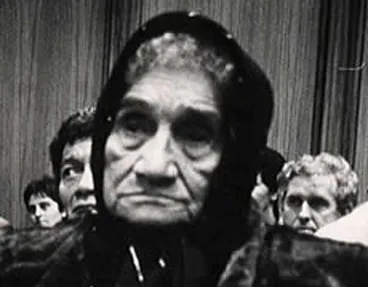
NZHistory: Biographies: Whina Cooper
Biographies: Whina Cooper
Manatū Taonga, the Ministry for Culture and Heritage
2019: "1975 Land hikoi: Tuia Mātauranga Curiosity Card" (DNZ story compiled by National Library Services to Schools)
1975 Land hikoi: Tuia Mātauranga Curiosity Card
DigitalNZ