Moose were introduced into aotearoa in the 1900s
First attempt in 1900
The first release of moose was into the West Coast ranges, with two bulls and two cows. These four animals were the only ones to have survived the voyage from an original group of fourteen sent from Canada.
1900 Importation of moose
Four moose to arrive, from Canada via Sydney, then released into South Island after a period of quarantine.
National Library of New Zealand
1900 Arrival of moose in Westland
Report of the arrival of moose, including information about this species and its original habitat
National Library of New Zealand
1900 Canadian hunter who accompanied the moose returns home
The Canadian says the "West Coast ranges will make an excellent breeding ground for the moose".
National Library of New Zealand
1900 The four moose show every signs of liking their new home
Four moose turned out by the Hokitika Acclimatisation Society at the head of the Hokitika River have paired.
National Library of New Zealand
Westland Acclimatisation Society reports on the settlement of the moose
Reports on sightings and the apparent health of the moose regularly appeared in the meeting minutes.
1900 Four moose released into Westland
Only 4 out of 14 moose survived the sea voyage
National Library of New Zealand
1901 The moose have been sighted
The Canadian moose were seen a day or two ago, looking in very good condition.
National Library of New Zealand
1901 Moose doing well
The moose were spotted and appear to be doing well
National Library of New Zealand
1901 Two moose pairs
The four moose have paired off, and appear to be doing well.
National Library of New Zealand
However, this first attempt was unsuccessful.
Despite initial enthusiasm about the adaptation of moose into New Zealand in 1900, the initial attempt didn't succeed. Although at least one cow moose appeared to be seen over the years, the bulls do not appear to have survived beyond the first year or two. The Westland Acclimatisation Society continued to report on the moose at their meetings.
From Te Ara, The first moose:
The first attempt to establish moose in New Zealand was in the Hokitika valley in [...] 1900. This failed.
1902
No known recent updates
National Library of New Zealand
1903
The two cow moose have been sighted, but nothing of the bulls
National Library of New Zealand
1904
The last of the cow moose left the Koiterangi district about 8 months ago, and nothing was seen of them until last week.
National Library of New Zealand
1907
One of the cow moose was seen in August last year.
National Library of New Zealand
1909
A moose was last seen on the Upper Kokatahi Road and is still in the vicinity.
National Library of New Zealand
1912
The cow moose was reported to have visited Messrs Lang & Bairds' farms, and appears well.
National Library of New Zealand
Second attempt to establish moose in New Zealand
When the second importation of moose happened, a larger group of 10 animals were released into a different region, further south in Dusky Sound. There was correspondence between New Zealand and Canada over several years to secure a starting herd of moose. However, this second arrival of moose did not actually happen until 1910 (not 1907 as reported below).
From Te Ara, The first moose:
[...] the second attempt was in 1907, when four bulls and six cows were imported from Canada and released in Dusky Sound.
1906 Canada to send moose to New Zealand
The despatch of the "best specimens of Canada moose" to New Zealand
National Library of New Zealand
1909 Young healthy moose being readied to be sent to New Zealand
National Library of New Zealand
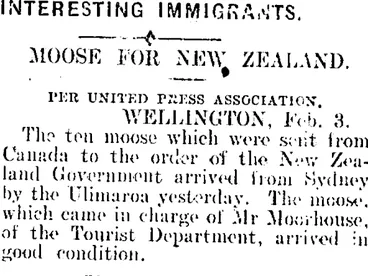
1910 The moose have arrived
Reports of the arrival of moose into New Zealand
National Library of New Zealand
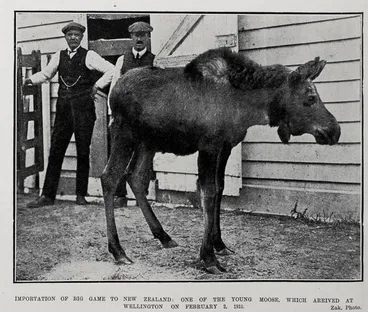
same species, different animals
Confusion about wapiti, elk and moose
Although hunters and scientists were clear about the differences, it's not always obvious to everyone else.
Who is a wapiti, who an elk? Press, 30 May 1986, Page 10.
This article gives background and dates of the introduction of the different animals to New Zealand over the years, as well as clarifying what the differences between the animals are.
Establishment of moose population in Fiordland
Before the first hunting licenses were issued in 1923, time was needed to ensure that the population was sufficiently established. Animals were sighted across the years, prior to the first moose being killed in 1929.
However, this was not without some trials, such as actually finding the elusive moose, confusion about whether sightings or hoof marks were of wapiti, large deer or moose, and having to estimate the population based on overseas breeding patterns without knowing whether this would be an accurate population representation in a new environment, especially with different plant species than they were used to eating in North America.
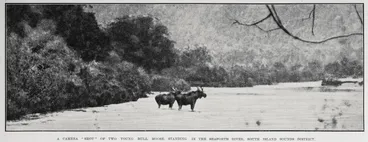
1921 Possible sightings in Dusky Sound
Report notes that the sightings are not definitively moose, as they may have been wapiti
National Library of New Zealand
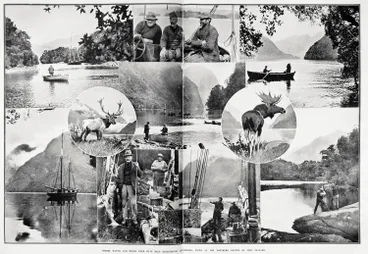
1921 Establishment in Southern Sounds
Auckland Libraries
1921 New herds discovered
Recent visit to the area by Mr Moorhouse at the request of the Southland Acclimatisation Society
National Library of New Zealand
1922 Lamenting the lack of expedition to find the moose
National Library of New Zealand
1923 Photograph of a moose
The Southland Acclimatisation Society received a telegram from Ranger Evans that he had secured photographs of moose.
National Library of New Zealand
1923 Hunting party reports sighting in Supper Cove
They estimated that there are now 118 moose and 2345 Wapiti in the fiord country.
National Library of New Zealand
1924 Moose have been sighted
Mr Murrell reports about his recent visit to the area, sighting moose and wapiti, but a lower population was estimated
National Library of New Zealand
1927 Moose and elk - magnificent specimens seen in Fiordland
The Murrell brothers report on their visit to Fiordland.
National Library of New Zealand
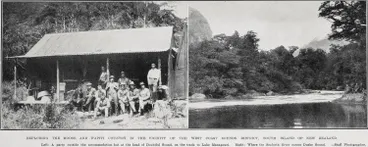
1928 Exploring Moose country
Auckland Libraries
But should they have even been introduced in the first place?
Not everyone was convinced that their introduction was a good option for New Zealand, even from the early years.
There are several printed reports (not yet digitised) about the introduction of non-native species into New Zealand, and the role of Acclimatisation Societies over the years.
- Gamekeepers for the nation : the story of New Zealand's acclimatisation societies, 1861-1990 / R.M. McDowall.
- The game animals of New Zealand : an account of their introduction, acclimatization, and development / by T. E. Donne, C.M.G. 1924.
1903 New Zealand as a Reserve for Big Game.
The writer is not convinced that this is a good opportunity for New Zealanders, especially farmers.
National Library of New Zealand
1932 Discussion of animal protections in Sounds National park
The question whether moose and wapiti should be protected was discussed at NZ Native Bird Protection Society.
National Library of New Zealand
Moose hunting as sport
From Te Ara, The first moose:
The first wapiti and moose hunting season was in 1923, with a limit of one animal per moose licence. On 9 September 1929 the first moose, a ten-pointer, was shot by E. J. Herrick.
However, moose hunting was not without its challenges, as it was another five years before the second moose was shot in 1934, and this was also by Mr E. J. Herrick.
The last moose known to be killed: The last moose to be shot in New Zealand: Percy Lyes with his prize at Herrick’s Creek, Wet Jacket Arm, 1952. Press, 12 August 1983, Page 18
![Image: Mitchell, Leonard Cornwall 1901-1971: Sport in New Zealand; deer stalking, moose & wapiti, fur and feathered game. [ca 1935].](https://images.digitalnz.org/-_IhhBoeApDkYJf6HGGCKhR3M4M=/368x0/https%3A%2F%2Fndhadeliver.natlib.govt.nz%2FNLNZStreamGate%2Fget%3Fdps_pid%3DIE1594 "Mitchell, Leonard Cornwall 1901-1971: Sport in New Zealand; deer stalking, moose & wapiti, fur and feathered game. [ca 1935].")
ca. 1935 "Sport in New Zealand" poster
Deer stalking, moose & wapiti, fur & feathered game
Alexander Turnbull Library
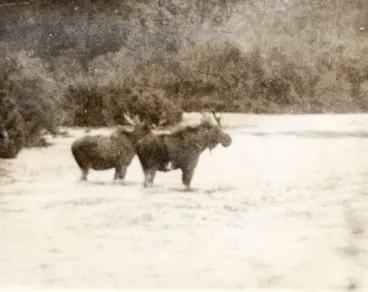
1927 Moose on the Loose
Central and Western Murihiku Southland Archive
1929 A sporting achievement of widespread interest
Mr. E. T. Herrick, of Hastings, returned from Dusky Sound with the first moose head.
National Library of New Zealand
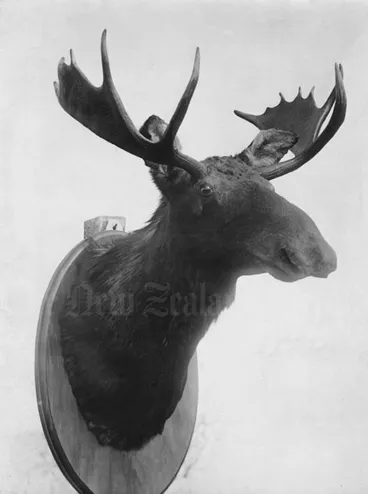
1929 The first moose killed in New Zealand hunting season
Although the first hunting season was 1923, it wasn't until 1929 that the first moose was killed.
Manatū Taonga, the Ministry for Culture and Heritage
1929 A hunter's description of stalking moose and wapiti
Mr Herrick, who killed the first moose, spoke of his recent hunting expedition
National Library of New Zealand
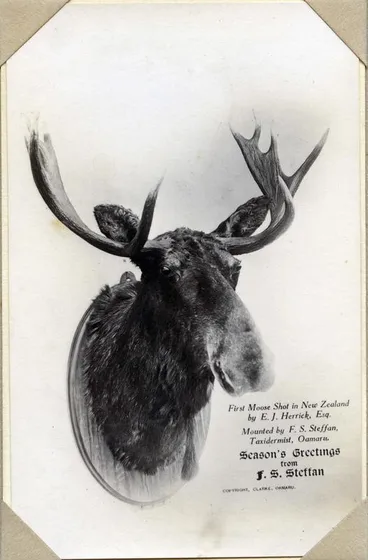
1929 Season's greetings
Photograph of the first moose head was sent as a Christmas card
Waitaki District Council
1934 Mr Herrick shoots second moose
National Library of New Zealand
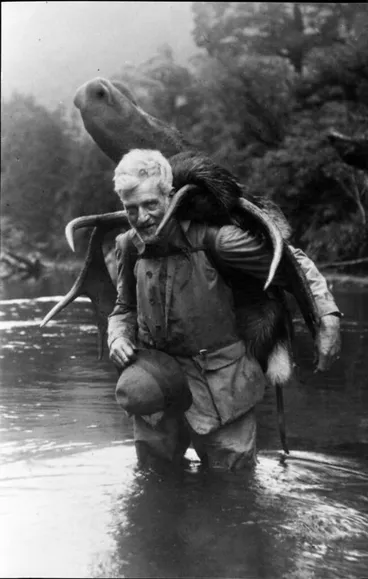
Date unknown. Hunter and moose
Archives New Zealand Te Rua Mahara o te Kāwanatanga
But are they still here?
Ken Tustin - New Zealand's best known moose hunter
With the last known moose to be shot in 1952, it is thought that the moose population may have survived through the following decades, but it has been difficult to prove this conclusively.
Otago scientist Ken Tustin has been looking for the elusive moose population in the South Island since the 1970s, and is regularly interviewed about the found evidence.
Newspaper articles relating to the 1972 research expedition
-
Reports of moose in Fiordland. Press, Volume CXI, Issue 32594, 30 April 1971, Page 17
- A bull moose is believed to have been shot in Wet Jacket Arm, Dusky Sound. It is believed that meat hunter shot the animal about five days ago and the trophy is being brought by fishing boat to Bluff.
-
Hunter saw two moose. Press, Volume CXI, Issue 32597, 4 May 1971, Page 4
- Mr Anderson [...] said he saw two moose—a bull and a cow—about nine days ago. The two moose he sighted were in fairly dense bush.
-
Expedition to solve mystery of moose. Press, Volume CXI, Issue 32769, 20 November 1971, Page 12
- A scientific expedition being planned by the Forest Service will in February search the steep, glaciated valleys and dense rainforest of Fiordland in an effort to find out how many of the only wild moose herd in the Southern Hemisphere remain.
-
Moose tracked in Fiordland. Press, Volume CXII, Issue 32895, 19 April 1972, Page 3
- The first official report that the only herd of moose in the Southern Hemisphere had survived in Fiordland was made tonight by the field scientist in charge of the group, Mr K. Tustin, who is attached to the Forest Service’s field and range experimental station at Rangiora. He said the party got so close to moose that they actually smelt them.
-
The elusive moose. Press, Volume CXVI, Issue 34104, 17 March 1976, Page 20
- Four years ago a Forest Service expedition brought back from the Dusky Sound area of Fiordland evidence suggesting that a small herd of moose still survived in this remote part of New Zealand. A larger expedition, mounted by the Deerstalkers’ Association, has found similar evidence—tracks: fresh droppings, and branches broken and stripped in a manner not associated with red deer.
1972 Research report about Fiordland trip (author K Tustin)
Visit to Fiordland in the areas suspected to support a moose population, in February to April 1972.
Manaaki Whenua – Landcare Research

2010 It is 100 years after the first release of moose into New Zealand
Ken Tustin may (or may not) have taken the first conclusive photograph of a moose in Fiordland in more than 50 years.
Radio New Zealand
2011 Photos revealed from 1953 hunting trip
Fred Stewardson's photos from 1953 are said to be the last definitive photographic evidence of moose in Fiordland.
Radio New Zealand
2015 Interview with Ken Tustin
Ken Tustin talks about new cameras installed in Fiordland, and reveals that the 1953 photos were not what they seemed.
Radio New Zealand
Reports of moose sightings and investigations have continued over the years
1980s
-
Call for the ‘black giants’ that once roamed Fiordland. Press, 12 August 1983, Page 18
- Somewhere in the lonely, dripping, rain forests of the remote mountains and valleys of Fiordland wander the cunning, long-faced survivors of New Zealand’s moose herd. Of this, hunter and story-teller, Ray Tinsley, of Hokitika, is firmly convinced.
-
On the trail of roaming moose. Press, 10 March 1987, Page 43
- Possible moose droppings found by a Wellington tramper, Alby Frampton, were given recently to the Deerstalkers’ Association for verification.
-
Moose may be in Fiordland. Press, 2 April 1987, Page 18
- Droppings found at Dusky Sound last month will go to the Smithsonian Institution in the United States to find out if they were left by a moose.
2010s
-
Secret snaps reveal elusive Fiordland moose. Otago Daily Times. 21 December 2012.
- Four photographs of moose taken by a hunter in Fiordland almost 60 years ago have finally been revealed publicly. Fred Stewardson (78), of Hikurangi, in Northland, took the photographs on a hunting trip to Wet Jacket Arm in 1953.
-
New Zealand's moose hunt: A century-long quest for a forest's final secret. Charlie Mitchell. Stuff. 24 May 2018
- Includes a last verified photograph of a moose in Fiordland (taken in 1952), and Part One: Saskatchewan to Supper Cove (audio) from Charlie Mitchell's investigation, "The Moose Hunt".
-
There are signs moose still live in NZ's wilderness. Charlie Mitchell. Stuff. 24 May 2018
- Includes Part Two: Broken branches (audio) from Charlie Mitchell's investigation, "The Moose Hunt".
2020 Interview with helicopter pilot who says he saw a moose
Having previously worked in Canada, he says he knows exactly what they look like.
Radio New Zealand
DigitalNZ Story updated in January 2025.