The Alexandra Clock - my dad's story
A DigitalNZ Story by Bridget Schaumann
My Dad was one of the men who built the clock on the hill in Alexandra. I'm recording his impressions of building the clock after interviewing him and searching through the photo collection that he kept. He died in September 2023.
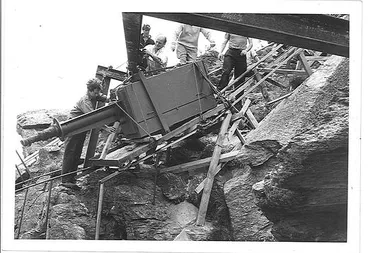
The mechanism for the clock being placed
Uploaded by DigitalNZ user Bridget Schaumann
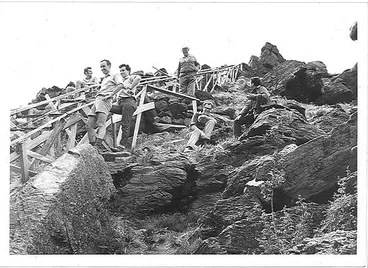
A railway to bring heavy items up the hill
Uploaded by DigitalNZ user Bridget Schaumann
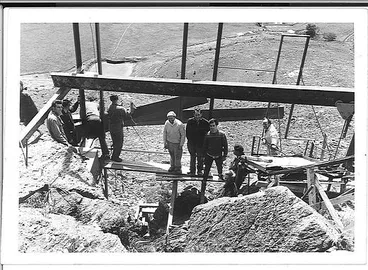
Jaycees on plank during the building of the clock
Uploaded by DigitalNZ user Bridget Schaumann
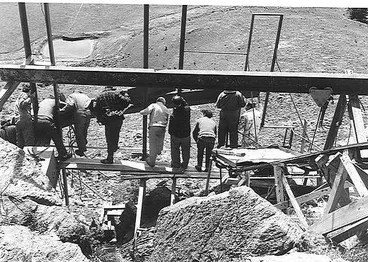
Clock makers looking out at the hands as they were installed.
Uploaded by DigitalNZ user Bridget Schaumann
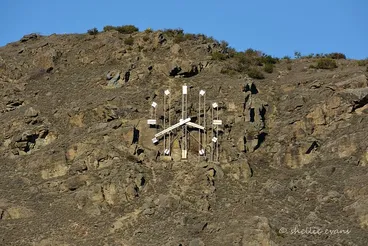
Alexandra's Clock on the Hill
Manatū Taonga, the Ministry for Culture and Heritage
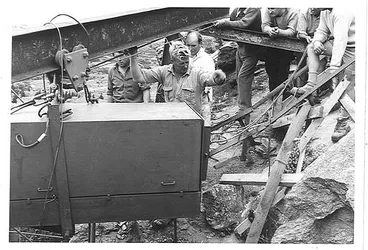
Graeme Hastie directing operations while installing clock mechanism
Uploaded by DigitalNZ user Bridget Schaumann
This will be a story, from my dad, Dick Schaumann's, perspective of how the clock came to be on the hill in Alexandra, a small town in Central Otago. Dad was a member of the Jaycees, the Junior Chamber of Commerce (a service organisation), for all the time he was a young man, up to the age of 41, Dad was a member. Members were aged out at 41. Beyond their 41st birthday, members became "Exhausted Roosters". I remember clearly Dad's certificate of Exhausted Rooster hanging proudly on the wall in our kitchen.
The Alexandra Chapter of the Jaycees was very active. Involved in many projects, such as toilet block construction, it was a round building and very cutting-edge for the time. It was the Jaycees' idea to have a blossom festival and float building for the procession, and quick-fire raffles to raise money for projects were a huge deal in the town. The Blossom Festival is as popular as ever now. They sold pies and drinks at the Manorburn Skating Dam to raise money, supported sports and hospitals and many other projects in the local area. They also created the park at the river junction.
But the clock is what they are most remembered for.
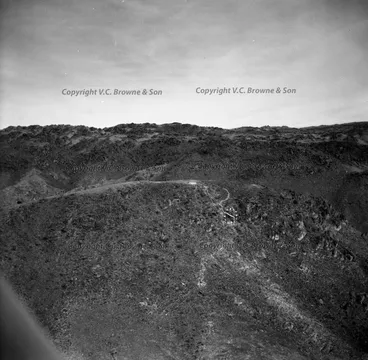
Alexandra clock (12838/12910)
V.C. Browne & Son
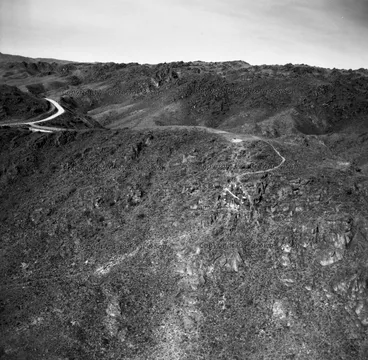
Alexandra clock. Little Valley Rd. top left (12838/12911)
V.C. Browne & Son
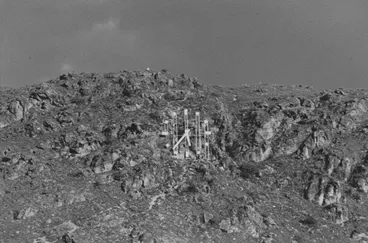
The Alexandra Clock
Te Whare o Rehua Sarjeant Gallery
Below is an edited transcript of an oral history of the clock by Dick Schaumann. Some of the details may be incorrect, but these are his recollections of what happened at the time.
The Alexandra Jaycees were looking for a big project in 1966. They were one of the leading clubs in the country. There was a brainstorm at one of the meetings, and someone (it is suspected that this was Mike Leamy, who was Dad's brother-in-law), came up with the idea of putting a clock on the hill. This seemed like a great idea, various options were explored, including putting it on the Old Man Range, but this was then dismissed. It was decided to place it on the hill that sits above the town. The range is known as the Knobbies locally.
Once the decision was made to go ahead with the clock, a mockup was made and put on the hill. This was made out of stuff that people had lying around, largely timber. The residents were surveyed. The local newspaper, the Central Otago News, objected to the clock; this was because one of the town's protesting voices was married to the editor, this is according to Dad. There were letters to the editor, and the paper was actively agitating against the clock because they felt that it would spoil the natural beauty of the hill. It seemed, though, that the majority of residents were excited about the project. It was decided to do a poll of the town's approximately 2,500 (at the time) residents. The results of this poll showed that 98% of the town was in favour of building the clock.
Once there was the ok from the townspeople, a power cable was installed up the hill. It didn't cost a lot because Bill King was an Engineer at the Power Board and an office holder at the Jaycees.
The Jaycees contracted J and AP Scots in Dunedin to design a mechanism. Dad thinks the contract might have been for about $600. This business was chosen because they were considered to be perfectionists, and they knew they'd get a functional product.
From this point, many people gave volunteer hours to bring the project to fruition, and there was a lot of in-kind support. The whole town got behind the project.
Money was raised by collecting scrap metal. Graeme Hastie, a bridge builder who ordered the steel for the project, and Bill King designed the clock face; the hour markers were made out of sheet metal, and it was decided to light up the face at night. This was largely done by Keith Campbell, who did experiments from Stewart Henderson's house to check for visibility. Eventually, it was decided to use torch bulbs to light the face. Bill King had a huge input into things like this.
Access to the worksite was via Little Valley Road, and a path was created up to the clockface from the bottom. A railway was created down to the clock from the top of the hill to get the clock parts in situ. They made a trolley thing that ran along a railway line by a long cable at the top of the hill, and this was attached to Keith Campbell's tractor.
The entire effort was paid for by the Jaycees, and the cost was covered by a scrap metal drive. Dad was heavily involved in this, driving our orchard truck around farms and orchards in the area to collect scrap, which was sold to raise money. The group met every fortnight in the tea rooms opposite where the Golden Cobweb was; these meetings were then moved to The Bendigo Pub.
The women were involved as well. Every weekend, there were wives rostered on to provide smoko and lunches for the men working on the clock. They were there all the time and couldn't afford the time to come down and get food, so it was taken up to them. I can remember this happening, the kids would all be packed into the car to go up and see the men at the clock with the food. I remember it was really exciting!
Because it was a time when nothing went to waste, the equipment that was used to make the clock was reused in projects on people's orchards and businesses. Dad made a bin trailer for his fruit picking bins out of some of the rails.
At the completion of the project, it was submitted for a national prize and won. I have the submission for this and will upload it at some point. There was a huge celebration for those who contributed at the Bendigo Pub.
Over time, the clock has been updated, and LED lightbulbs that change colours for the season have been installed. The mechanism has had work done on it, and the clock has survived vandals and time. It is the thing that the town is renowned for. Everyone looks for the clock on the hill.
In 2018 a lookout was built on top of the hill near the clock. It is a popular place with visitors as the views are fantastic.