First trans-Tasman flight landed 11 Sept 1928
A DigitalNZ Story by Zokoroa
First trans-Tasman flight when the Southern Cross arrived in Christchurch from Sydney on 11 September 1928
Southern Cross, Aircraft, Plane, Trans-Tasman, Tasman Sea, Flying, Flight, Aviation, Charles Kingsford Smith, Fokker, Arctic, Alaska, Pacific, Detroiter
The Southern Cross was the first aircraft to cross non-stop over the Tasman Sea when it arrived at the Wigram Aerodrome in Christchurch on Tuesday 11 September 1928 at 9:22am. The Fokker Tri-Motor monoplane had departed from the Richmond Aerodrome, northwest of Sydney, on 10 September at c.5:27pm (Australian time). The four crew on board were three Australians (pilot Charles Kingsford Smith, co-pilot Charles Ulm, and navigator Harry Litchfield) and a New Zealander (radio operator Tom McWilliams). After reaching the lower North Island, they flew over Wellington and then travelled south to Christchurch and were welcomed by over 30,000 people waiting at Wigram. The Southern Cross had flown a distance of 2670 kms in 14 hours and 25 minutes. Nicknamed the 'Old Bus', it had an average cruising speed of 185 kms per hour due to the high winds encountered.
The following gives an overview of:
Trans-Tasman flight by the Southern Cross; the civic receptions held throughout NZ; and the return flight to Sydney.
Remarkable background of the Southern Cross - from being an Arctic explorer plane called the Detroiter in 1926; to being bought by Smith and Ulm in August 1927 who renamed it the Southern Cross after the constellation for the first trans-Pacific flight achieved in mid-1928; to the planning behind and the completion of the first non-stop trans-Tasman flight in September 1928.
-
What happened to the Southern Cross, and commemorations in NZ and Australia.
>>>>>>>>>>>>>>>>>>>
1. Trans-Tasman flight by the Southern Cross and civic receptions

'Southern Cross' was 1st plane to fly trans-Tasman (Sydney-Christchurch) after 14 hr & 25 min flight on 10-11 Sept 1928
'Southern Cross' was a Fokker F.VIIb/3m Tri-Motor with 3 J-5B Whirlwind engines; c.73 foot wingspan & c.40 feet length
Canterbury Museum
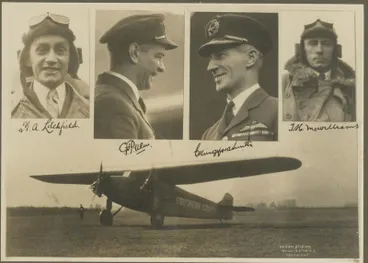
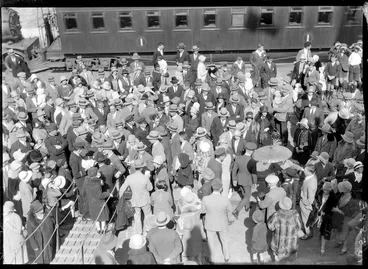
A crowd of c.30,000 greeted the 'Southern Cross' and its four crew who then attended civic receptions
Crew: Pilot Charles Kingsford Smith, Co-pilot Charles Ulm, Navigator Harry Litchfield, & Radio operator Tom McWilliams
Hawke's Bay Museum
1(a) Southern Cross departed Sydney on Mon 10 Sept 1928 at c.5:27pm (Aus time)
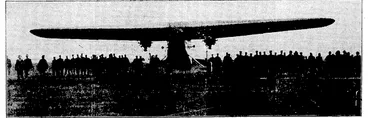
On Mon 10 Sept 1928, the 'Southern Cross' departed from from Sydney to fly to Christchurch at c.5:27pm (Aus time)
NZ was 1.5 hours ahead of Sydney. (Note: Varied engine start, taxiing & lift off times are given in historical accounts)
National Library of New Zealand
The 'Southern Cross' was scheduled to depart from Richmond Aerodrome on 1 Sept, but bad weather delayed its take-off
Richmond Aerodrome (former RAAF Base Richmond) is located 50 kms (31 miles) northwest of Sydney
National Library of New Zealand
On board were letters from the Aust PM Bruce to NZ PM Coates, & Aust Gov-General Stonehaven to NZ Gov-General Fergusson
Other mail was also transported on the flight
National Library of New Zealand
Crew were three Australians and a New Zealander

Crew were three Australians (Smith, Ulm & Litchfield) & a NZder (McWilliams)
NZ Govt had arranged for McWilliams, a teacher at Union Steam Ship Co.'s radio school in Wellington, to represent NZ
Victoria University of Wellington
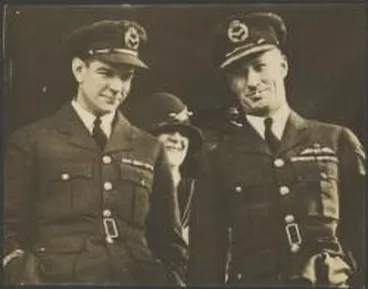
Australian pilots Smith & Ulm had achieved first Trans-Pacific flight in June 1928 & received honorary ranks in RAAF
RAAF appointed Smith as honorary Squadron Leader & Ulm as Flight- Lt & both received the Air Force Cross
Trove

Australian navigator Harry Litchfield had worked with Smith during Australian aerial trips & was invited by Smith
He had advanced skills in astronomical & dead-reckoning navigation (calculating current position from previous one)
Trove

The NZ Govt arranged for wireless operator Tom McWilliams to represent NZ
McWilliams was a teacher at Union Steam Ship Company's radio school in Wellington
Alexander Turnbull Library
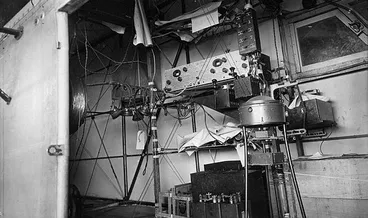
View of McWilliams' position inside the cockpit from where wireless radio & Morse code messages were sent
Air Force Museum of New Zealand
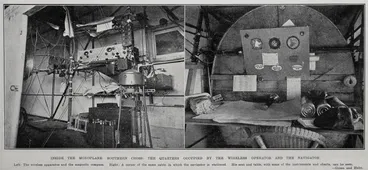
View of Litchfield's position on the other side of the cockpit with navigation instruments
Written notes on a long pole were passed between the cockpit & pilots' compartment due to noisiness of the 3 engines
Auckland Libraries
Broadcasting Company arranged radio transmissions of the flight from IYA Auckland, 2YA Wellington, & 3YA Christchurch
Morse messages from plane were translated. 2FC Sydney used its shortwave station for listeners in Britain, Europe, & US.
National Library of New Zealand
Memorial wreaths dropped during flight across the Tasman Sea

On reaching c.240kms off the coasts of both Australia & NZ, memorial wreaths were dropped by the crew for 2 RNZAF pilots
National Library of New Zealand

Capt Hood & Lt Moncrieff had attempted first-ever trans-Tasman on 10 Jan 1928 but lost their lives
Their Ryan B.1 monoplane 'Aotearoa' went missing between Sydney & Wellington & they were not found
National Library of New Zealand
The NZ Govt had organised a wreath on behalf of New Zealanders, & the Australian crew decided to also drop a wreath
NZ's wreath which had NZ flowers & shrubs & a NZ Ensign was given to McWilliams to take aboard the Southern Cross
National Library of New Zealand
Storm encountered half-way across, damaging propellers & radio contact lost
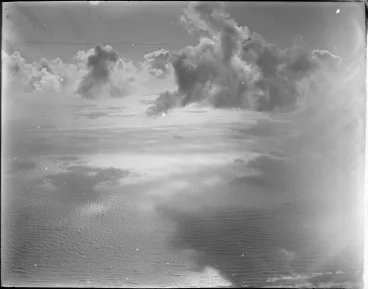
Half-way across Tasman Sea, 'Southern Cross' encountered heavy rain, hail & ice during an electrical storm
Auckland Libraries
Windscreen was coated obscuring pilots' vision; 3 propellers were damaged; & radio contact lost until c.5pm (Aus time)
National Library of New Zealand
1(b) Circled over Wellington at 7.20am (NZ time) & then flew south to Christchurch

On Tues 11 Sept 1928 at 7.20am (NZ time), 'Southern Cross' passed over & circled Wellington; then flew to Christchurch
Auckland Libraries
Escorted by four Bristol Fighters with cameraman aboard

At 8:20am, four Bristol F2B Fighters flew north from Wigram Aerodrome to meet & escort the 'Southern Cross'
The Bristol Fighters were from the New Zealand Permanent Air Force (NZPAF)
Wairarapa Archive
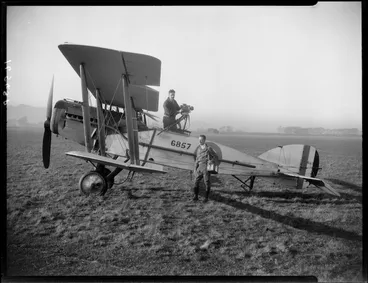
The Bristol Fighters were led in F2B 6857 by Captain Maurice Buckley who carried cameraman Frank McKechnie on board
Alexander Turnbull Library
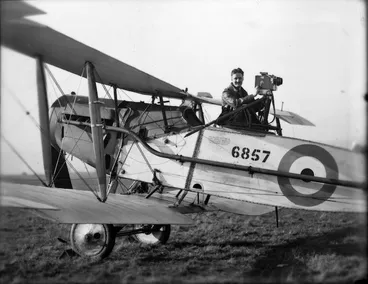
McKechnie, who was from Govt's Publicity Office at Dept Internal Affairs, lashed his camera's tripod to the fuselage
Alexander Turnbull Library
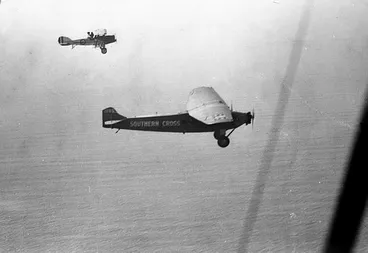
At 9am, they met the 'Southern Cross' above Amberley
McKechnie can be seen filming from the cockpit of the Bristol Fighter
Air Force Museum of New Zealand
They escorted the 'Southern Cross' to Wigram whilst McKechnie filmed the journey
(Amberley lies c.42kms north of Christchurch)
Auckland Libraries
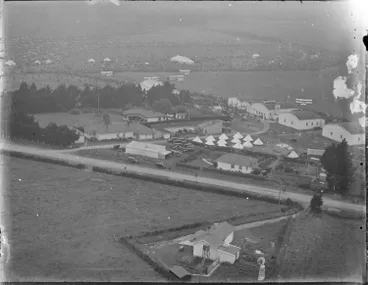
Crowd had started gathering at Wigram Aerodrome, Christchurch since 7:30am
Preparations for the arrival at Wigram Aerodrome & traffic management were described by Evening Post (3 Sept)
(The former privately-owned Sockburn Aerodrome had been renamed Wigram when the Government took over ownership in 1923.)
National Library of New Zealand
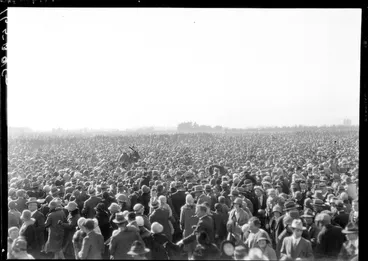
At 7.30am, crowds started assembling, alerted by radio reports of the 'Cross' over Wellington, & reached 30,000 by 9am
Alexander Turnbull Library
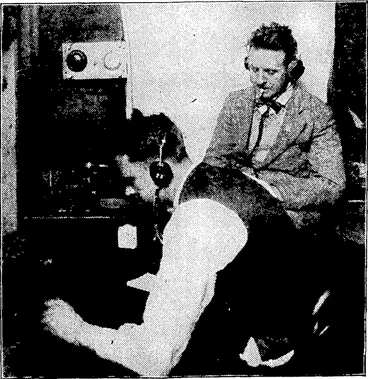
Reports were also being received by & relayed from the Wireless Room operators at Wigram
National Library of New Zealand

Crowd included pupils from state schools who were given the day off
Canterbury Photography Museum
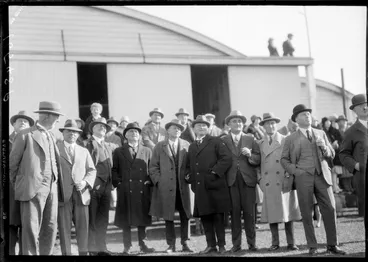
Public servants were granted time off until 11am
Alexander Turnbull Library
'Southern Cross' circled overhead at Christchurch
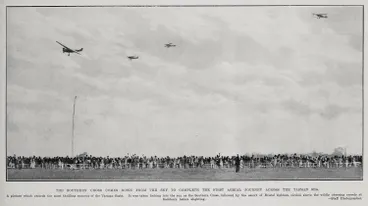
On reaching Christchurch, the 'Southern Cross' circled overhead & began its descent to the Wigram Aerodrome
Auckland Libraries
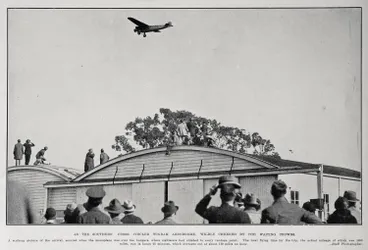
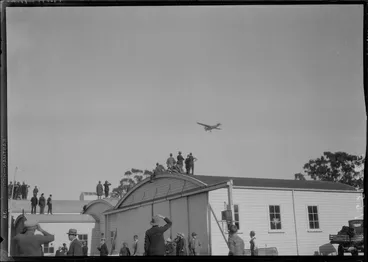
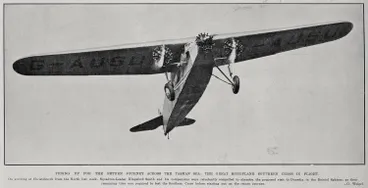
Arrival of the Southern Cross at Christchurch. Plane in flight, over hanger
Alexander Turnbull Library
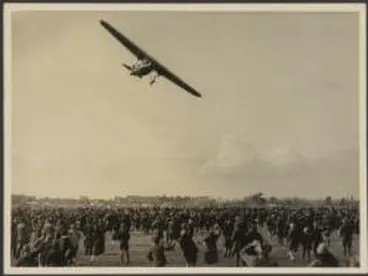
1(c) Touched down at Wigram on 11 Sept at 9:22am after 14 hours 25 min flight
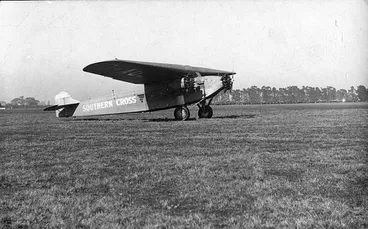
On 11 Sept at 9:22am (NZ time), Southern Cross touched down at Wigram having flown 2670kms non-stop in 14 hours 25 mins
The Fokker Tri-Motor, nicknamed the ‘Old Bus’, had an average cruising speed of 185 kms per hour due to high tail winds
Air Force Museum of New Zealand
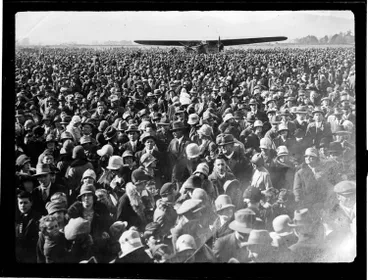
The crowd swarmed towards the 'Southern Cross'
Auckland Libraries
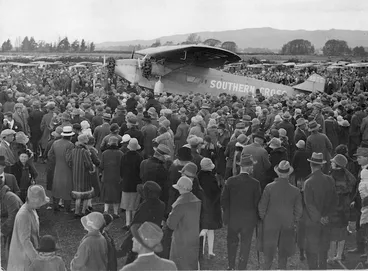
Crowd welcoming the aeroplane Southern Cross, Wigram
Alexander Turnbull Library
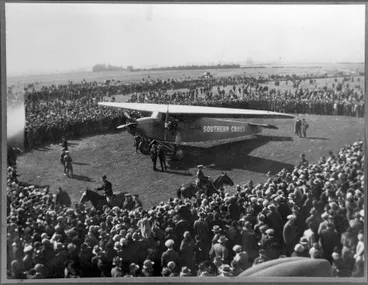
Police on horseback had to clear the crowd back
Palmerston North City Library

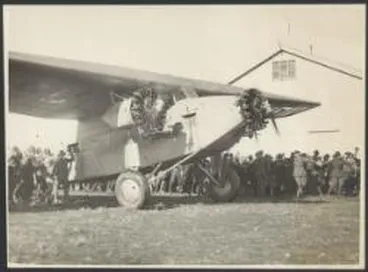
The Southern Cross taxied to the hangar with the police clearing a pathway
Trove
![Image: Charles Ulm climbing out of the cockpit of Fokker F.VIIb/3m, VH-USU, Southern Cross, 1928 [picture].](https://images.digitalnz.org/EXNlieYqczyXDnNxkE5mfnKOLws=/368x0/http%3A%2F%2Fnla.gov.au%2Fnla.pic-vn4925187-v "Charles Ulm climbing out of the cockpit of Fokker F.VIIb/3m, VH-USU, Southern Cross, 1928 [picture].")
Co-pilot Charles Ulm climbing out of the cockpit
National Library of Australia
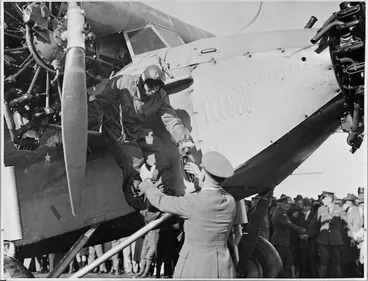
Pilot Charles Kingsford Smith wearing his flying helmet with black cat good luck charm on top being assisted
Alexander Turnbull Library
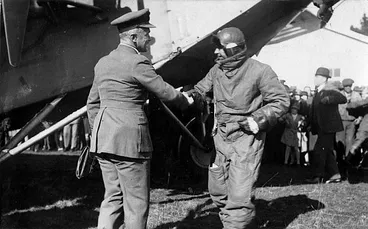
Commanding officer of the Wigram Air Base, Captain James Findlay welcomed each crew member
Air Force Museum of New Zealand
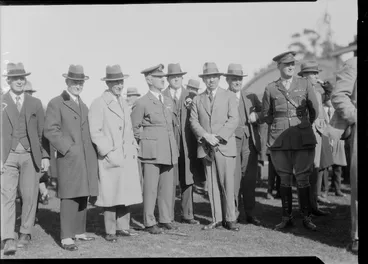
Official party: Deputy Mayor Dan Sullivan; Sir H. Rhodes (Legislative Counci) & Major Wilkes (Director of Air Services)
The Christchurch Mayor, Rev John Archer, was unable to get through the crowd to make the official welcome
Alexander Turnbull Library

After donning coats, the 'Southern Cross' crew were given silver ferns, one of which is held by the Air Force Museum
The crew wore traditional civilian/military aviator's heavy leather or wool coat
Alexander Turnbull Library
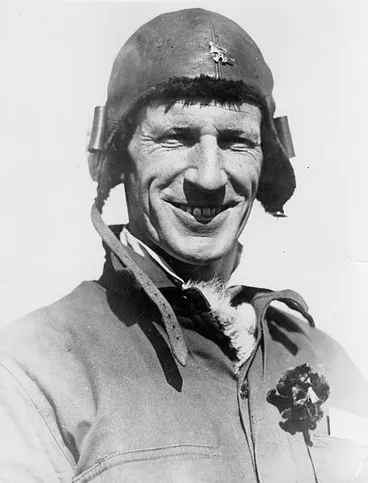
During the throng, Smith lost his flying helmet which was found later without its black cat good luck emblem
(The helmet, which he gave to the young girl who found it, is now in the Air Force Museum)
Air Force Museum of New Zealand
![Image: Portrait of T.H. McWilliam, Charles Kingsford Smith, Charles Ulm and H.A. Litchfield at Wigram Aerodrome, Christchurch, New Zealand, 11 September 1928 [picture] /](https://images.digitalnz.org/oKeREJ1xXnNHFn_XcvcJrJA5_5U=/368x0/http%3A%2F%2Fnla.gov.au%2Fnla.pic-vn3930808-t "Portrait of T.H. McWilliam, Charles Kingsford Smith, Charles Ulm and H.A. Litchfield at Wigram Aerodrome, Christchurch, New Zealand, 11 September 1928 [picture] /")
The crew changed from their flying gear & had a commemorative photograph taken by Ernest Boulter
(Later, Litchfield & sons of Kingsford-Smith, Ulm & McWilliams signed the photo at Christchurch Airport on 9 Sept 1978.)
National Library of Australia
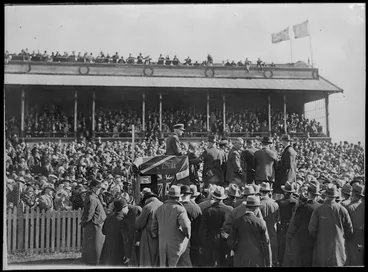
After the police were able to clear a pathway through the crowd, the formal welcome took place by the official party
Alexander Turnbull Library
![Image: Charles Kingsford Smith in RAAF uniform speaking at a civic reception, with Charles Ulm, T.H. McWilliam and government representative Sir Heaton Rhodes seated in front row, Christchurch, New Zealand, 11 September 1928 [picture] /](https://images.digitalnz.org/5Rhdj7T9-8IpEAEV3BHZwWgsEUY=/368x0/http%3A%2F%2Fnla.gov.au%2Fnla.pic-vn3930761-t "Charles Kingsford Smith in RAAF uniform speaking at a civic reception, with Charles Ulm, T.H. McWilliam and government representative Sir Heaton Rhodes seated in front row, Christchurch, New Zealand, 11 September 1928 [picture] /")
Smith addressed the crowd during the formal reception
National Library of Australia
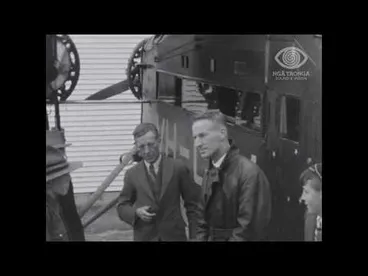
The arrival of the 'Southern Cross' & initial reception were filmed. See: Youtube (2:34mins).
(RNZ: "First Trans-Tasman flight: Kingsford Smith lands at Wigram in the 'Southern Cross', 1928" )
Radio New Zealand
First trans-Tasman airmail also arrived
![Image: Philatelic 'cover' [envelope], first air crossing of the Tasman](https://images.digitalnz.org/NjVXkvjfCggT8aMjm2zEtKn-DgI=/368x0/https%3A%2F%2Fmedia.tepapa.govt.nz%2Fcollection%2F417615%2Fpreview "Philatelic 'cover' [envelope], first air crossing of the Tasman")
First unofficial trans-Tasman airmail delivered. (Image of envelope of a letter transported on the 'Southern Cross')
Museum of New Zealand Te Papa Tongarewa
1(d) Civic reception held at Cranmer Square in Christchurch on 12 Sept 1928
The crew then travelled by car to stay at Ernest and Sybil Boulton's United Service Hotel in Cathedral Square
Cathedral Square was the centre of Christchurch's main tram service
Christchurch City Libraries
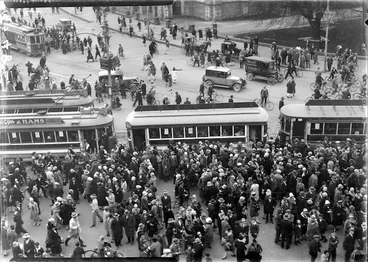
The following morning (12 Sept), a crowd had begun gathering outside the Hotel
Alexander Turnbull Library
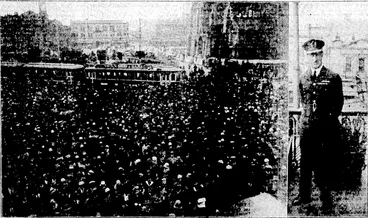
Smith stepped out onto a balcony of the Hotel at 10:10am to wave to the crowd
National Library of New Zealand
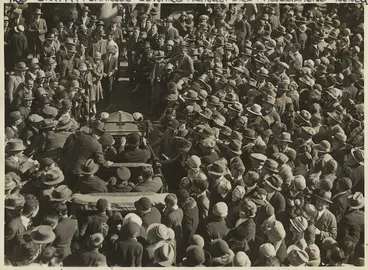
'Southern Cross' crew left the Hotel by open car for the civic reception being held at 12 noon at Cranmer Square
Alexander Turnbull Library
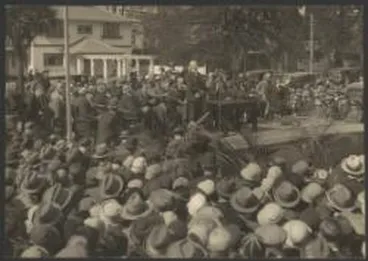
At Cranmer Square, they were officially welcomed by MP Sir Heaton Rhodes & Mayor of Christchurch The Rev. John K. Archer
Rhodes welcomed them on behalf of the Government & Archer on behalf of Christchurch
Trove

Smith speaking at the civic event
Canterbury Photography Museum
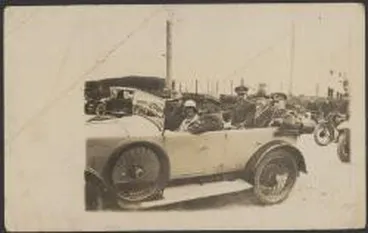
Afterwards, they journeyed to the civic luncheon held at the Winter Garden on Madras St near Armagh St
Trove
1(e) Southern Cross repaired at the Wigram Aerodrome

Meanwhile, the 'Southern Cross' underwent repairs to the damage caused during the storm over the Tasman Sea
The wing edges had been battered and all three of the Westinghouse Micarta propellers damaged
Canterbury Photography Museum
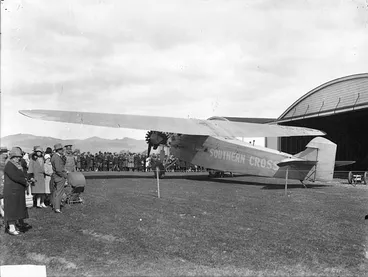
The repairs were undertaken by the New Zealand Permanent Air Force (NZPAF) mechanics at the Wigram Aerodrome
They patched the battered wings, overhauled the engines & replaced the propellers ordered & shipped from Sydney
Air Force Museum of New Zealand
1(f) Crew toured North & South Islands by Bristol Fighter planes & cars
The crew attended receptions throughout NZ whilst the Southern Cross had its propellers repaired in Christchurch after being damaged during an electrical storm. They were transported by Air Force crew on three of the Bristol Fighter planes and also toured by car to cities and towns.
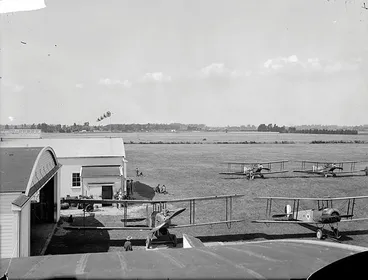
Whilst 'Southern Cross' was unavailable due to repairs, the crew used 3 of the Bristol Fighter planes to tour around NZ
Air Force Museum of New Zealand
![Image: New Zealand Permanent Air Force Bristol F.2B biplane fighter, 7120, parked on an airfield, New Zealand, 1928 [picture].](https://images.digitalnz.org/7gb81mx5fEXFMJ4ykMfo2eKQ72w=/368x0/http%3A%2F%2Fnla.gov.au%2Fnla.pic-vn4925355-v "New Zealand Permanent Air Force Bristol F.2B biplane fighter, 7120, parked on an airfield, New Zealand, 1928 [picture].")
The three F2B Fighters: 6856, 6857 and the dual control 7120
National Library of Australia
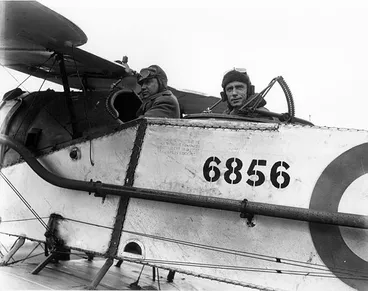
Captain Buckley (front seat) & Tom McWilliams, Wireless Operator, sitting in Bristol Fighter 6856
Air Force Museum of New Zealand
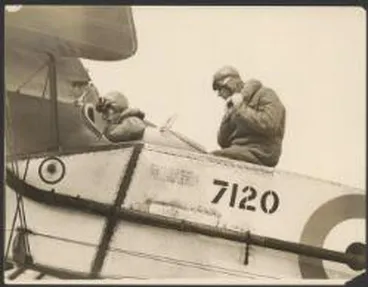
Charles Kingford Smith & Charles Ulm in cockpit of Bristol Fighter 7120
Trove
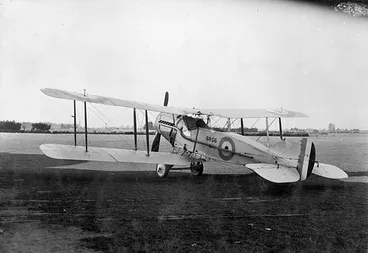
The 3 Bristol Fighters flew via Woodbourne Airport in Blenheim to the North Island
While at Woodbourne, Kingsford Smith & Ulm, were made honorary members of the New Zealand Air Force (Reserve)
Air Force Museum of New Zealand

The crew attended civic receptions in North & South Islands
Auckland Libraries
Wellington:
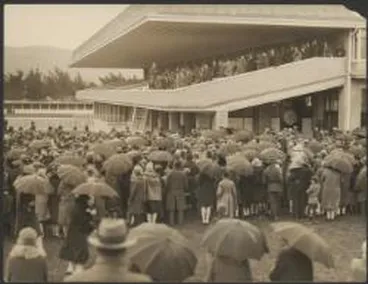
Wellington: On 12 Sept 1928, flew by Bristol Fighters to the Trentham Racecourse where landed on the home straight
Trove
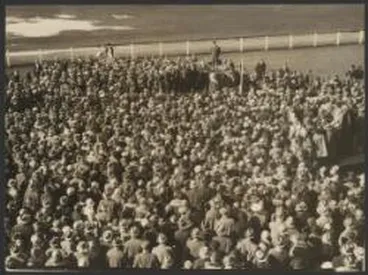
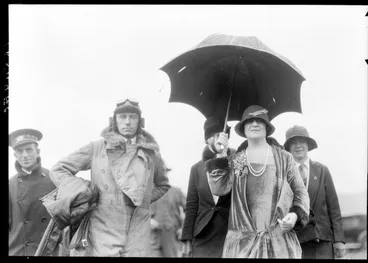
Arrival of the Southern Cross at Wellington, possibly Trentham. Radio operator T H McWilliams
Alexander Turnbull Library
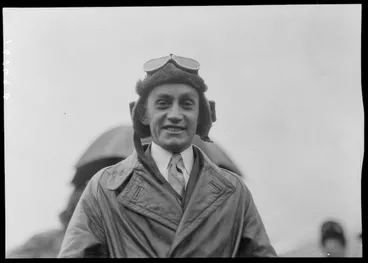
Arrival of the Southern Cross at Wellington, possibly Trentham. Navigator H A Litchfield
Alexander Turnbull Library
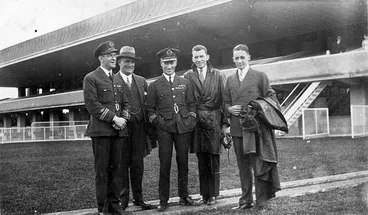
Crew with Denzil Ardell (Dpt of Internal Affairs). L-R: Ulm, Ardell, Kingsford Smith, McWilliams, & Litchfield.
2021-019.9
Air Force Museum of New Zealand
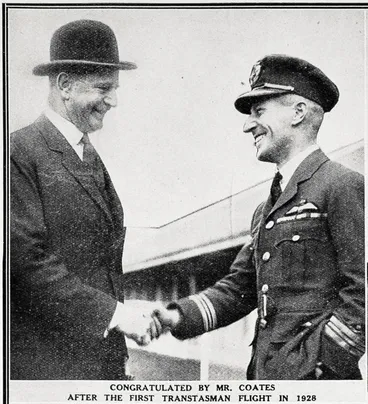
On Govt's behalf, Prime Minister Joseph Coates congratulated Smith
Auckland Libraries
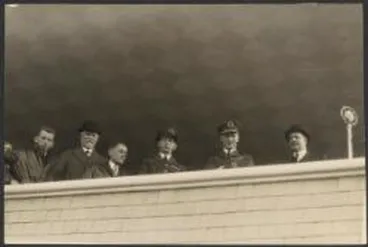
![Image: Arrival of the Southern Cross at Wellington, possibly Trentham. C Kingsford Smith and [C P Ulm?] at microphone](https://images.digitalnz.org/eZjh46U8SvaePOQizqE-fDTWijw=/368x0/https%3A%2F%2Fndhadeliver.natlib.govt.nz%2FNLNZStreamGate%2Fget%3Fdps_pid%3DIE2385926 "Arrival of the Southern Cross at Wellington, possibly Trentham. C Kingsford Smith and [C P Ulm?] at microphone")
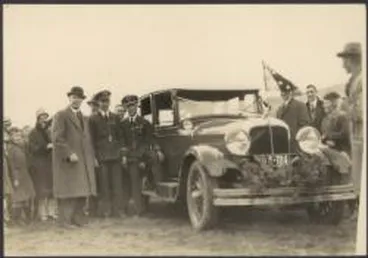
'Southern Cross' crew then journeyed by car around Wellington
Trove

On 17 Sept 1928, the official Government luncheon took place at Parliament House in Wellington
Trove
On Govt's behalf, PM Coates presented a film of the arrival of the 'Southern Cross' & a £2,000 honorarium
National Library of New Zealand
Hawera:
![Image: Charles Kingsford Smith and Charles Ulm in cockpit of Bristol Tourer biplane, being met on arrival by Mayor George Baildon at Auckland, New Zealand, September 1928 [picture] /](https://images.digitalnz.org/_PChBoOm3z3oypuOUkTIIB-1wEk=/368x0/http%3A%2F%2Fnla.gov.au%2Fnla.pic-vn3930782-t "Charles Kingsford Smith and Charles Ulm in cockpit of Bristol Tourer biplane, being met on arrival by Mayor George Baildon at Auckland, New Zealand, September 1928 [picture] /")
On 19 Aug, flew from Wellington to civic reception held at the Hāwera racecourse; & then on to Auckland
National Library of Australia
Auckland:
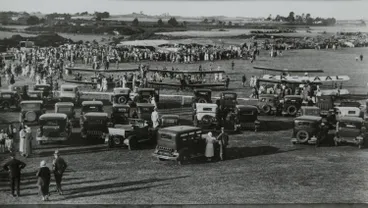
A crowd had gathered at Mangere Aerodrome for the reception organised by local authorities & the Auckland Aero Club
The Auckland Aero Club had officially opened the airfield on flat land near Ihumātao in July 1928
Auckland Libraries
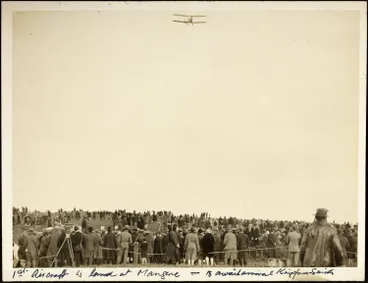
Waiting for Kingsford Smith, Māngere, 1928
Auckland Libraries
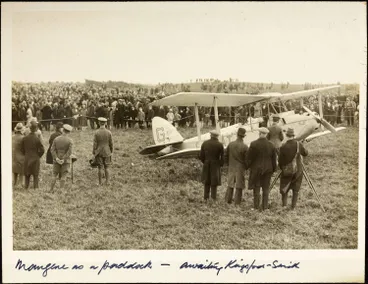
Waiting for Kingsford Smith, Māngere, 1928
Auckland Libraries
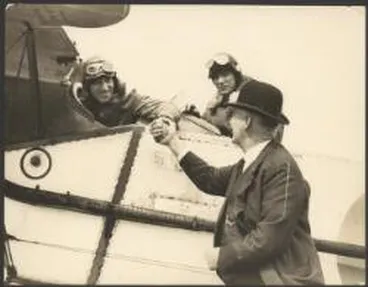
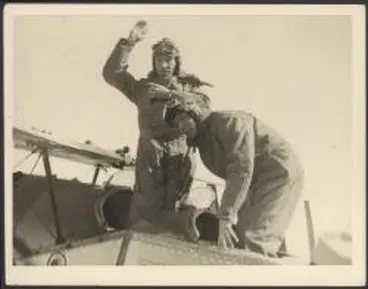
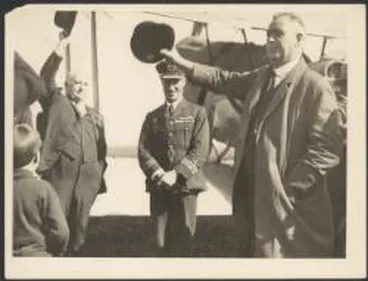
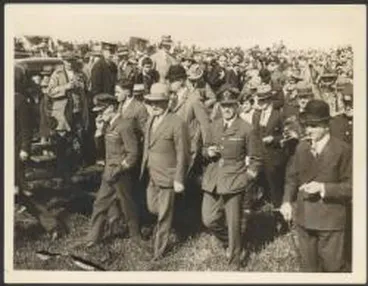
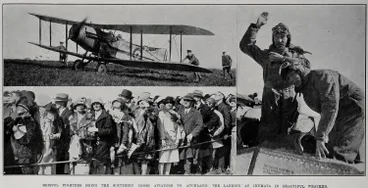

Smith visited Point Chevalier School
Auckland Libraries
Road trip to Hamilton, Cambridge & Rotorua:
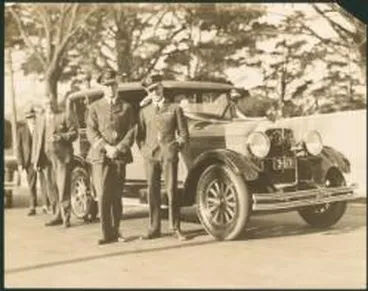
From Auckland, the crew toured by car through Hamilton, Cambridge & Rotorua; then returned to Auckland
Trove
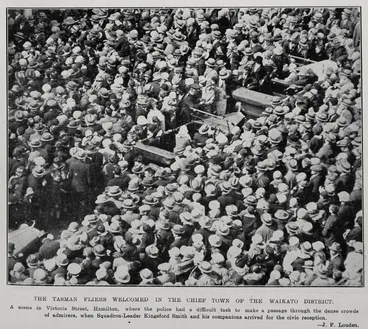
Crowd in Victoria Street, Hamilton welcoming the aircrew
Afterwards, the aircrew attended a civic reception at the Cambridge Town Hall where they were greeted by 1500 people
Auckland Libraries
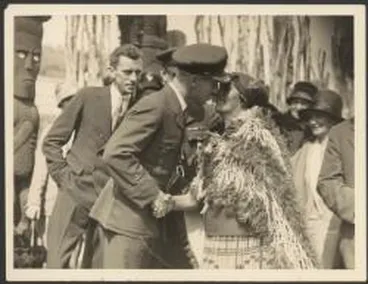
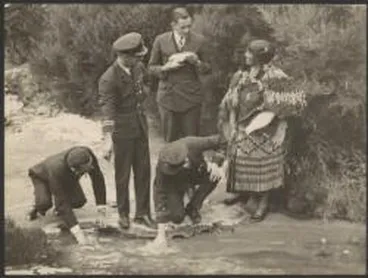
Aircrew visited Rotorua where they were shown around the hot pool with Guide Bella
Trove
![Image: McWilliam, Kingsford-Smith, Guide Bella, Ulun [?] and Lichfield at Whakarewarewa.](https://images.digitalnz.org/djdOb0omNlOzWc_eN8YetzB2nEk=/368x0/https%3A%2F%2Fimages.ehive.com%2Faccounts%2F3064%2Fobjects%2Fimages%2F2rvvat_174_l.jpg "McWilliam, Kingsford-Smith, Guide Bella, Ulun [?] and Lichfield at Whakarewarewa.")
McWilliam, Kingsford-Smith, Guide Bella, Ulun [?] and Lichfield at Whakarewarewa.
Rotorua Museum of Art & History Te Whare Taonga o Te Arawa
![Image: Crew of the Southern Cross, at the hot pools with guide, Bella, Rotorua, New Zealand, September 1928 [1] / Weekly News](https://images.digitalnz.org/1vWrChf3aY5RlB45y681uR7JaOY=/368x0/http%3A%2F%2Fnla.gov.au%2Fnla.obj-147668252%2Fimage%3FWID%3D250 "Crew of the Southern Cross, at the hot pools with guide, Bella, Rotorua, New Zealand, September 1928 [1] / Weekly News")
Sir Charles Kingsford Smith at the Bath House
Rotorua Museum of Art & History Te Whare Taonga o Te Arawa
Returned by car to Auckland & flew to Wanganui, Blenheim & Christchurch:
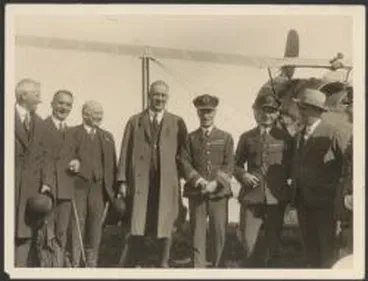
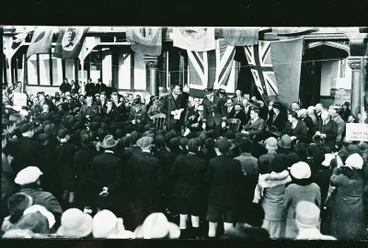
After visitng Rotorua, they travelled by car to the Auckland Airport
Trove
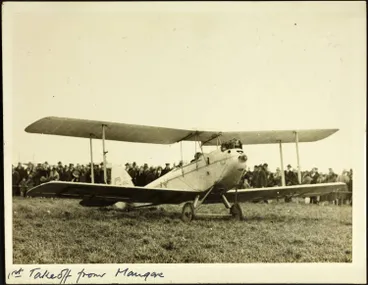
They then flew to Christchurch, via Wanganui & Blenheim
Auckland Libraries
![Image: [Charles Ulm, Charles Kingsford Smith and unidentified man surrounded by crowd, Wanganui, New Zealand, 1928?]](https://images.digitalnz.org/DE3PkGHN9iYtHM_afQXmmsBD8BM=/368x0/http%3A%2F%2Fnla.gov.au%2Fnla.obj-144664476%2Fimage%3FWID%3D250 "[Charles Ulm, Charles Kingsford Smith and unidentified man surrounded by crowd, Wanganui, New Zealand, 1928?]")
Image: Ulm & Kingsford Smith were greeted at Wanganui
Trove
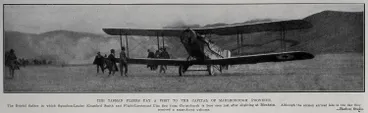
Kingsford Smith & Ulm visited Blenheim
Auckland Libraries

1(g) Repaired Southern Cross makes test flights at Wigram, Christchurch
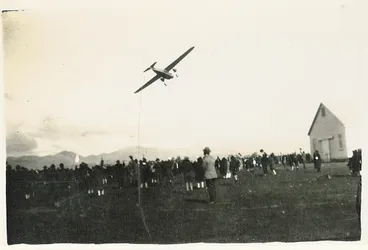
At Wigram the 'Southern Cross' made its first flight on 27 Sept after the repairs were completed
Tasman District Libraries
Two further test flight were held with guests & sightseers over Christchurch
National Library of New Zealand

Image of one of the test flights over the Christchurch Cathedral
Auckland Libraries
1(h) Southern Cross flown from Christchurch to Blenheim on 28 Sept 1928

On 28 Sept 1928, 'Southern Cross' & crew were farewelled at Wigram as they departed for Blenheim to fly back to Sydney
Trove
Memorial slab erected at Wigram during the farewell
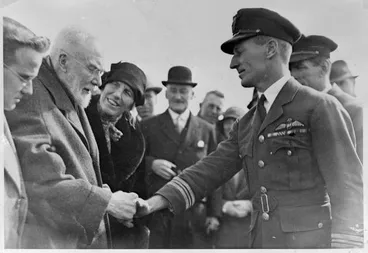
Sir Henry Wigram & Lady Agnes Wigram were amongst those who bid farewell to Smith & rest of the crew at Wigram
Wigram had opened the Sockburn airfield for his flying school in 1918 & gave it to Govt in 1923 who then renamed it
Auckland Libraries
During the farewell, an inscribed slab was laid at the Wigram Aerodrome to mark the spot where the Southern Cross landed
National Library of New Zealand
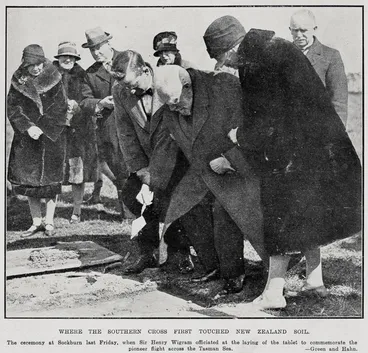
Sir Henry Wigram officiated at the laying of the memorial stone slab
The spot was preserved as 'Charles Kingsford Smith Landing Site Memorial' with plan-view outline of the 'Southern Cross'
Auckland Libraries
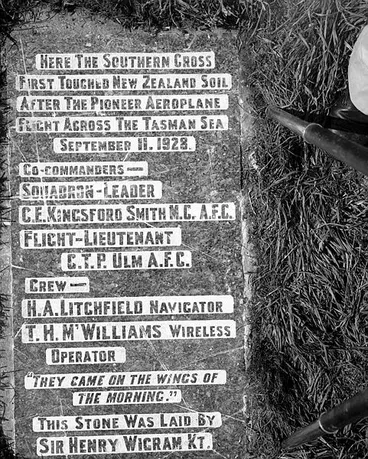
The memorial slab was removed in 1982 when the land was ear-marked for housing & stored at the Air Force Museum
The original slab was replaced with a metal version which nowadays lies at Bennington Way in Wigram Skies subdivision
Air Force Museum of New Zealand
'Southern Cross' arrived at Blenheim where greeted by crowd
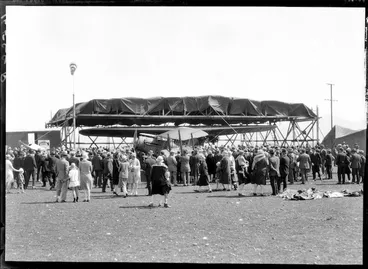
A crowd greeted the 'Southern Cross' on its arrival at Blenheim
Alexander Turnbull Library

Scenes captured at Blenheim of the 'Southern Cross' & its crew during the weekend of 29-30 Sept 1928
Auckland Libraries
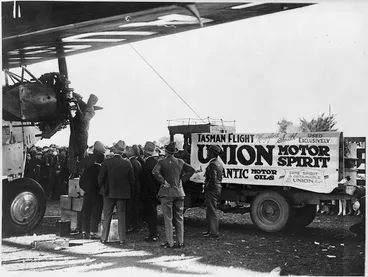
The 'Southern Cross' was refuelled & its propellers were adjusted in readiness for the flight back to Sydney
Alexander Turnbull Library
1(i) Southern Cross departed from Blenheim to Sydney at c.4:51am on 13 Oct 1928
Evening Post reports unfavourable weather delaying the departure of the 'Southern Cross' (3 Oct)
Article also describes the various gifts the four crew received during their NZ tour
National Library of New Zealand
On Sat 13 Oct 1928, after weather improved, the 'Southern Cross' taxied off in front of about c.5000 people
The plane was escorted for 160kms by two Bristol Fighters flown by Captains Findlay & Buckley
Alexander Turnbull Library
The 'Southern Cross' left Blenheim at c.4:51am (NZ time) for Sydney
(NZ time was 2 hours later than Australian time due to daylight saving starting in NZ in Oct)
Auckland Libraries
An account of the radio transmissions during the return flight of the 'Southern Cross' to Richmond
National Library of New Zealand
1(j) Arrival at Richmond, Sydney at 1.42am (Aus time) on 14 Oct 1928 after 22 hours 51 min flight
On 14 Oct, the crew landed at Richmond, Sydney at 1:42am (Aus time) after 22 hours 51 min flight
Severe weather, heavy fog, & navigational error added to the flight time. On landing, they had 10 minutes of fuel left.
National Library of New Zealand
International accolade for historic trans-Tasman flight

On 9 Sept 1930, Smith was presented by the International League of Aviators with the trophy for best flight of 1928
The trophy was presented at Australia House in London by Sir Granville Ryrie, the High Commissioner for Australia
National Library of New Zealand
>>>>>>>>>>>>>>>>>>>>>>>>>>>>>>>>>>>>>>>>>>>>>>>>>>>>>>>>>>>>>>>>>>>>>>>>>>>>>>
2. Remarkable background of the Southern Cross
The following summarises the Tri-Motor design of the Southern Cross and its journey from being named the 'Detroiter' in Alaska to becoming the 'Southern Cross' for the first trans-Pacific flight, followed by the first non-stop trans-Tasman flight. The flight home of the Southern Cross back across the Tasman and its later ventures are also summarised.
a. Fokker Tri-Motor monoplane designed and manufactured in 1925
b. Ordered for Arctic expedition & named 'Detroiter' in March 1926
c. Sold & renamed Southern Cross (Aug 1927) for trans-Pacific flight held mid-1928
d. Non-stop trans-Tasman flight held with the Southern Cross on 10-11 Sept 1928
e. What happened to the Southern Cross?
f. Commemorations
>>>>>>>>>>>>>>>>>>>>>>>>>>>>>>>>>>>>>>>>>>>>>>>>>>>>>>>>>>>>>>>>>>>>>>>>>>>>>>
2(a) Fokker Tri-Motor monoplane designed and manufactured in 1925
Evolved from earlier designs for a single-motor and a Tri-Motor Fokker

'Southern Cross' was a Fokker F.VIIb/3m Tri-Motor designed at Anthony Fokker's Amsterdam aircraft factory in late 1925
Fokker (maker), F.VIIb (design version 7 b), & 3m (3 motors). Fokker began Royal Netherlands Aircraft Factories in 1912.
Tauranga City Libraries

Fokker had arranged for engineer Reinhold Platz to modify the single-motor F.VII designed by Walter Rethal in 1924-25
F.VII & its 360 hp Rolls-Royce Eagle V-12 engine was enlarged to F.VIIa with 400 hp Packard Liberty engine in early 1925
Auckland Libraries
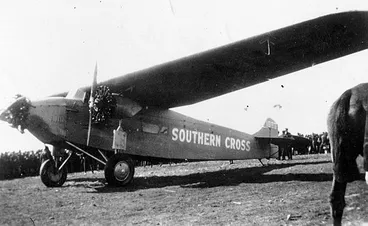
Platz initially designed the Tri-Motor F.VIIa/3m & then enlarged its length, wingspan & motors to create the F.VIIb/3m
F.V11a maiden flight was on 4 Sept 1925; then entered in Ford Reliability Tour in US which led to designing the F.VIIb
Air Force Museum of New Zealand

FVIIb length was c.40 feet & its single cantilever wing c.73 feet long built from spruce & covered with a plywood skin
The welded steel-tube fuselage was covered with plasticised lacquered fabric for airtightness & weather-proofing
National Library of New Zealand

'Southern Cross' was powered by three engines with one mounted under its nose & one mounted under each wing
Original J-4 engines (200 hp each) installed in Dec 1925/Jan 1926 were enlarged to J-5B (220 hp each) in Aug 1927
Auckland War Memorial Museum Tāmaki Paenga Hira
Fokker's manufacturing locations included New Jersey for sales in US

Anthony Fokker's manufacturing locations included the Fokker Aircraft Corporation in New Jersey for US sales
Both the single-motor & the Tri-Motor Fokkers were manufactured at New Jersey
Digital Public Library of America
>>>>>>>>>>>>>>>>>>>>>>>>>>>>>>>>>>>>>>>>>>>>>>>>>>>>>>>>>>>>>>>>>>>>>>>>>>>>>>
2(b) Ordered for Arctic expedition & named 'Detroiter' in March 1926
Tri-Motor & single-motor ordered in December 1925 for 'Detroit Arctic Expedition'

Australian George Wilkins intended to use Fokkers to explore Arctic north of Alaska for uncharted lands in March 1926
Aim was to map & explore unknown areas of the Arctic Ocean & drop American flags to claim land for the US
Auckland Libraries

He'd been notified by his friend Vilhjalmur Stefansson that businessmen in Detroit wanted to sponsor an Arctic flight
Stefansson had led Canadian Arctic Expedition in 1913 with Wilkins as photographer, & saw Wilkins as an ideal leader
National Library of New Zealand
In Dec 1925, Wilkins ordered a Fokker Tri-Motor with J-4 engines & a single-motor with Liberty engine from New Jersey
A 2d Tri-Motor was burnt in factory's fire & not reordered. (Wilkins' background reported by Evening Post, 6 Feb 1926)
National Library of New Zealand
Estimates of each plane's engine capacity & flying distance without refuelling were stated by Evening Post (22 Jan 1926)
National Library of New Zealand

Supply bases were set up in Alaska at Fairbanks near rail from Seaward port & 500 air miles north at Point Barrow
Plan was to ship & reassemble the Fokkers at Fairbanks; then fly to Point Barrow to conduct searches over Arctic Ocean
Antarctica New Zealand

Oil, supplies & tri-motors were shipped from the US & sledges bought from Seaward for 1000 mile trek to Point Barrow
After 65 miles, the snow-motors were replaced by husky dogs due to the deep snowdrifts & gasoline usage
Auckland Libraries

On 21 Feb 1926, Wilkins & Fokkers in crates arrived by ship at Seaward, Alaska & went by train to Fairbanks
Wilkins' team included US pilots Carl Eiselson & Thomas Lanphier & mechanics Charles Wisley & Andrew Hufford
National Library of New Zealand
Tri-Motor named 'Detroiter' after sponsors & single-motor named 'Alaskan', March 1926
After being reassembled, Tri-Motor was named 'Detroiter' after expedition's supporters & single-motor named 'Alaskan'
Supporters included Detroit businessmen; The Detroit Times; Detroit Aviation Society; & American Geographical Society
National Library of New Zealand
'Alaskan' & 'Detroiter' damaged during test runs & later flights, March - May 1926
During the test runs on 18-19 March, 'Alaskan' was partly wrecked on landing & 'Detroiter's engines & propeller damaged
Repairs began on both planes with the spare parts (which included one engine each) that had been shipped with the planes
National Library of New Zealand
On 31 March, repaired 'Alaskan' flown by Wilkins & pilot Carl Eielsen on expedition's first flight to Point Barrow base
National Library of New Zealand
By mid-April, 'Detroiter's bent metal propeller was replaced by a wooden one & its engines refixed
Evening Post reported that by 15 April one of the Detroiter's engines had been fuelled and fired up (16 April 1926)
National Library of New Zealand
On 19 April 1926, 'Detroiter' had test run with pilot Lanphier & reached 10,000 feet in 30 mins during its hour trial
"The machine...was handled beautifully during an hour's trial" reported the Evening Post (21 April 1926)
National Library of New Zealand
On 22 April, when helping search for overdue 'Alaskan', 'Detroiter' had engine trouble near Arctic Circle & turned back
Cargo had to be jettisoned as its central engine's cylinder had died, making it unable to rise up over the Brooks Range
National Library of New Zealand
On 6 May 1926, 'Alaskan' was damaged beyond repair on landing at Fairbanks & 'Detroiter' was used to fly to Point Barrow
Media reported Alaskan's propeller was splintered; wings torn to shreds; & landing gear on right side a tangled wreck
National Library of New Zealand
On 8 May, during a trial flight, the 'Detroiter' was the first aircraft seen by Eskimoes living beyond Point Barrow
It had flown from Fairbanks to Point Barrow & then northward; & then back to Point Barrow to return to Fairbanks
National Library of New Zealand
On 30 May 1926, it was reported Lanphier, after repeated trial flights, was dissatisfied with Detroiter's performance
As the weather was also foggy, it was speculated the expedition would not be extended over the icepack that year
National Library of New Zealand
In early June 1926, Detroit Arctic Expedition was halted by the Board of Control due to engine issues & foggy weather
The Board intended to discuss with Wilkins the expedition's future plans & possible purchase of new aircraft
National Library of New Zealand
Arctic expedition resumed as 'Detroit News Expedition' with Stinson planes, March - June 1927
On 2 Jan 1927, Wilkins announced the Arctic expedition would resume with the Detroit News as sponsor
The Detroit businessmen had ceased their sponsorship & the expedition was renamed 'Detroit News Expedition'
National Library of New Zealand
In March 1927, Wilkins brought 2 lighter planes to Fairbanks: Stinson SB1 Detroiter 4 seat bi-planes built in Michigan
He thought the Stinsons would be easier than the Fokkers to land & manage on uneven polar ice
National Library of New Zealand
Stinson planes too small & Detroiter to be repaired in Seattle but Wilkins decided to sell it, June 1927
As Stinson had less room for supplies & crew, Wilkins tried to rebuild 'Alaskan' with Detroiter's wing & use metal skis
However, during take-off, the skis didn't slide easily. 'Alaskan' fell over & snapped a ski. Wilkins discarded his idea.
National Library of New Zealand
In June 1927, following foggy weather, Wilkins returned to US & sent Detroiter to Boeing factory in Seattle for repairs
Detroiter's wing was transferred back from the Alaskan & it was shipped in crates without its 3 damaged J-4 engines
National Library of New Zealand

Wilkins then decided 'Detroiter' was too large & heavy for Arctic weather & to sell it to buy a Lockheed Vega 1
Vega 1 had 225hp, air-cooled 9-cylinder Wright Whirlwind J-5 radial engines & room for pilot & 4 passengers
New Zealand Maritime Museum
>>>>>>>>>>>>>>>>>>>>>>>>>>>>>>>>>>>>>>>>>>>>>>>>>>>>>>>>>>>>>>>>>>>>>>>>>>>>>>
2(c) Sold & renamed 'Southern Cross' (Aug 1927) for trans-Pacific flight held mid-1928
Wilkins met Charles Kingsford Smith & Charles Ulm in San Francisco in Aug 1927

In Aug 1927, Wilkins met Charles Kingsford Smith & Charles Ulm in San Francisco who'd planned a trans-Pacific flight
Alexander Turnbull Library
Smith & Ulm had planned a Trans-Pacific flight with support of Australian Government
During 1926, the Australian Government had increasingly encouraged flying for travel purposes & subsidised aero clubs
National Library of New Zealand
Flights within Australia & to Pacific Islands were also carried out by the RAAF for future defence purposes during 1926
National Library of New Zealand

Smith, a former WWI pilot, had formed Interstate Flying Services in Sydney in early 1927 with Lt Keith Anderson
They'd met in 1922 when flying with Western Australian Airways in Perth; then began a trucking business in 1924
Auckland War Memorial Museum Tāmaki Paenga Hira

Ulm, a former soldier, had begun a commercial aviation business after learning to fly & contacted Smith to amalgamate
National Library of New Zealand
Smith, Anderson & Ulm formed a partnership & unsuccessfuly tendered for new Adelaide-Perth mail delivery contract
The successful tenderer, West Australian Airways in Perth, already had experience in mail delivery
National Library of New Zealand

They began planning a trans-Pacific flight from San Francisco to Sydney with fuel & rest stops at Honolulu & Suva
Digital Public Library of America
A trans-Tasman flight had also been considered, but they decided to focus on the trans-Pacific flight first
Newspapers had reported on the speculation in Australia & NZ as to who would be first to achieve a trans-Tasman flight
National Library of New Zealand

As publicity for trans-Pacific flight, Smith & Ulm flew a Bristol Tourer on 18-29 June 1927 from Sydney around Australia
Funded by Vacuum Oil Co, they flew record time of 10 days & 5.25 hours, beating 44 days set in 1924 by two RAAF officers
Digital Public Library of America

On landing back at Sydney, they were greeted by NSW Premier Lang who pledged $3500 grant for their trans-Pacific flight
National Library of New Zealand
Intended to purchase a new Fokker & attempt the trans-Pacific flight in Nov 1927

Smith & Ulm had decided to buy a new Fokker Tri-Motor & commence the trans-Pacific flight in Nov 1927
They considered the single-engine Bristol Tourer they'd flown in Australia lacked the range & fuel capacity needed
Digital Public Library of America

On 15 July 1927, Smith, Ulm & Anderson left Sydney on SS Tahiti & sailed via Wellington to San Francisco
Whilst Smith & Ulm bought the Fokker plane, Anderson planned to checked out an ideal fuel stop site at Honolulu
Australian National Maritime Museum
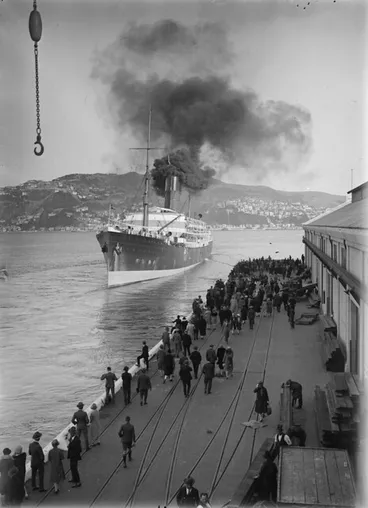
When berthed at Wellington, Smith met ex-RAF friend F.S. Napper & discussed having a trans-Tasman flight
Napper, who lived in Christchurch, was invited to be a passenger on the Tasman flight & to be the contact/agent in NZ
Alexander Turnbull Library
After leaving Wellington on 18 July, Smith, Ulm & Anderson arrived at San Francisco on 5 Aug 1927
When in Wellington, they'd declined to discuss their plans with reporters as had a contract with an Australian newspaper
National Library of New Zealand
Detroiter sold by Wilkins (Aug 1927) & repaired by Smith & Ulm for trans-Pacific flight
On meeting Wilkins, Smith & Ulm bought the 'Detroiter' for $3000 as it didn't have engines or navigation instruments
NSW Premier Lang had increased the $3500 grant pledged in June 1927 to $4500 in Aug 1927 for buying a Fokker plane
National Library of New Zealand
Meanwhile, Anderson had continued on to Honolulu to check a suitable fuel stop landing place for the Pacific flight
National Library of New Zealand

Smith & Ulm installed three larger J-5B Whirlwind engines with £1,500 grant from Melbourne retailer Sidney Meyer
One engine was mounted directly on the nose & one under each wing (Image: 1928)
Canterbury Photography Museum
Evening Post (29 Sept 1927) gave plane's dimensions as wingspan: 73ft & length: 40ft; & petrol capacity of 1600 gallons
(Note: Other media reports & sources have variously described the plane's dimensions & fuel capacity)
National Library of New Zealand
'Detroiter' was renamed 'Southern Cross' after the constellation:

The Detroiter was renamed the 'Southern Cross' after the constellation that would help guide at night across the Pacific
Registered to Charles E. Kingsfon Smith, et al, 18 Oct 1927 by US Dpt of Commerce Aeronautic Branch. Assigned: NC1985.
Auckland Libraries
Trans-Pacific flight postponed due to funding issues & new sponsor sought
In Oct 1927, Smith asked newly elected NSW Premier Bavin for further funding but was denied over flight safety concerns
Groups, including RSA, had voiced concerns over safety of the airmen who, although brave, would be risking their lives
National Library of New Zealand
The trans-Pacific flight was postponed & Smith set out to beat world's non-fuel endurance record to raise funds
As the flights were to be held across north & south Califonia, an US pilot was required & Lt George Pond joined Smith
National Library of New Zealand
'Southern Cross' temporarily renamed 'The Spirit of California', Dec 1927 - Jan 1928
In Dec 1927, 'Southern Cross' temporarily repainted as 'The Spirit of California' for sponsors Associated Oil Company
Of 5 flights held in Dec 1927-Jan 1928, the best time of 50 hrs & 40 mins beat the world record of 52 hrs & 22 mins
National Library of New Zealand
Due to ongoing funding issues, 'Southern Cross' sold to Capt. Hancock in April 1928
In April 1928, due to ongoing funding issues, the 'Southern Cross' was sold to US philanthropist Capt Hancock
The 'Southern Cross' was sold by Smith & Ulm for $16,000 to Hancock whom Smith had previously taught to fly
National Library of New Zealand
'Southern Cross' loaned by Hancock for trans-Pacific flight, 31 May - 9 June 1928

Hancock loaned 'Southern Cross' to Smith & Ulm for flight from Oakland, California to Brisbane on 31 May - 9 June 1928
The flight path from California to Brisbane had fuel & rest stops en route at Honolulu in Hawaii & Suva in Fiji
National Library of New Zealand

Crew (L-R): James Warner, Charles Ulm, Charles Kingsford Smith & Capt Harry Lyon
Warner (radio/wireless/operator) had trained in US Navy & Lyon (navigator) had served in the US Merchant Marine
Auckland Libraries

On 31 May 1928, they left Oakland, California at 8:53am & arrived at Honolulu on 2 June 1928 at 9:49am
At Wheeler Field in Honolulu, they refuelled the Southern Cross & had a rest stop
National Library of New Zealand

On 2 June, they departed Honolulu at 5:20am & arrived at Suva, Fiji on 4 June at 2:21pm
They landed at Albert Park cricket ground
Auckland Libraries

They were greeted by a crowd who were seeing the first plane to land at Fiji
Auckland Libraries

On 7 June, they flew to Nasilani Beach (30 kms away) to refuel for their departure the next day on 8 June at 2.52pm
Auckland Libraries

When the 'Southern Cross' neared the coast of Queensland, the news was received by Smith's parents
Auckland Libraries
On 9 June 1928, the 'Southern Cross' landed at Brisbane's Eagle Farm Airport at 10:50am
They were met by c.15,000 at touchdown & c.25,000-30,000 lined the road to the civic reception held at the Town Hall
National Library of New Zealand

The trans-Pacific flight covered c.7,250-mile (11,670km) & totalled c.83 hours & 11 mins of flying time
(Smith & Ulm wrote "Story of the 'Southern Cross" 1928")
Auckland War Memorial Museum Tāmaki Paenga Hira

The crew then flew 'Southern Cross' to Sydney (10 June), Melbourne (13 June) & Canberra (15 June) for civic receptions
At Melbourne, Smith was appointed RAAF honorary Squadron Leader & Ulm Flight-lieutenant; & both awarded Air Force Cross
Alexander Turnbull Library
By 12 June 1928, £16,500 had been raised from Federal, State, private & public subscription grants for Smith & Ulm
Further sums were later raised, including $10,000 each for Lyon & Warner from Californians & William Randolph Hearst
National Library of New Zealand
Hancock sent congratulatory telegram transferring ownership to Smith & Ulm

Smith & Ulm received a congratulatory telegram from Hancock transferring ownership of 'Southern Cross' to them
(US registration 1985 can be seen on the tail & was also painted on the upper surface of the wing)
Canterbury Photography Museum
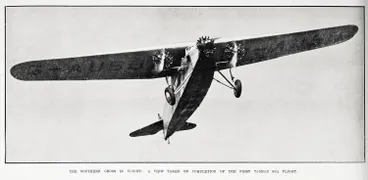
On 4 July 1928, 'Southern Cross' was issued with Certificate of Registration G-AUSU [No 210] to Smith & Ulm
G-AUSU was painted on undersurface of the wing (see enlargement of photo). The US registration 1985 was also retained.
Auckland Libraries
'Southern Cross' nicknamed 'Bus' and 'Old Bus'
During the trans-Pacific flight, the Southern Cross came to be nicknamed 'bus’ by its crew as a term of endearment. 'Bus' was a common term used at the time for any large vehicle or aircraft that was steady and reliable. The term 'bus' was also used after the landing of the Southern Cross at Christchurch: Papers Past: "Brilliant Tasman pilots", Evening Post (Vol. CVI, Issue 54, 12 Sept 1928, p.12)
Smith also named his autobiography 'The Old Bus' (Melbourne: Herald Press, 1932). The use of 'old' reflected how the Tri-Motor monoplane had flown Smith and crew safely during the non-fuel endurance flights around California; the trans-Pacific journey and later flights.

The 'Southern Cross' was affectionately nicknamed 'bus' by the crew for its steadiness & reliability
Smith also named his autobiography 'The Old Bus' (1932) which reflected how it had safely flown on its flights
Auckland War Memorial Museum Tāmaki Paenga Hira
>>>>>>>>>>>>>>>>>>>>>>>>>>>>>>>>>>>>>>>>>>>>>>>>>>>>>>>>>>>>>>>>>>>>>>>>>>>>>
2(d) Non-stop trans-Tasman flight held with the Southern Cross on 10-11 Sept 1928
After completing the trans-Pacific flight, Smith and Ulm finalised their plans to achieve the first non-stop trans-Tasman flight. They successfully flew the Southern Cross from Sydney to Christchurch on 10-11 September 1928.
Flight path & crew preparations

Smith & Ulm, after completing their trans-Pacific flight on 9 June 1928, began planning a trans-Tasman flight to NZ
National Library of New Zealand

Earlier on 10 Jan 1928, 2 RNZAF pilots had attempted first-ever trans-Tasman but lost their lives
MOTAT

Smith & Ulm discussed routes from Sydney to NZ with their US navigator Lyon & wireless operator Warner
Trove
During June 1928, speculation rose in NZ as to where Smith would fly to - Christchurch or Wellington
National Library of New Zealand
On 11 June 1928, Mr Napper who was Smith's agent in NZ was "practically certain" Christchurch would be the landing place
He'd sent a cablegram to Smith & was awaiting a reply. (They'd first met in Wellington when Smith went to US in 1927)
National Library of New Zealand
On 11 June 1928, the Canterbury Progress League & Canterbury Aviation Club invited Smith to land at Christchurch
National Library of New Zealand
On 12 June 1928, a deputation met with the Wellington Mayor George Troup who agreed to cable an invite to Smith
Deputation: Wellington Chamber of Commence, Manufacturers' Association, Employers' Association, & the Civic League
National Library of New Zealand
On 13 June 1928, UPA reported Smith had announced "the New Zealand trip will be undertaken within a few weeks"
The UPA (United Press Association) announcement was published by the Evening Post on 13 June 1928)
National Library of New Zealand
On 15 June 1928, APA unofficially stated flight to NZ would be conducted under auspices of Australian & NZ govts
The news from APA (Australian Press Association) was published by the Evening Post on 16 June 1928
National Library of New Zealand
On 15 June 1928, APA also reported Smith had invited Warner & Lyon to join the NZ flight but they wanted to return to US
Evening Post: "... they have withheld their decision to see whether any Australians will volunteer for the honour"
National Library of New Zealand
On receiving the news of Lyon's mother's death, Lyon & Warner sailed for San Francisco aboard SS Sanoma on 23 June 1928
Lyon later radioed from the ship on 27 June that a woman with same name as his mother died. (Evening Post, 27 June 1928)
National Library of New Zealand
Non-stop flights planned from Sydney to Perth & from Sydney to NZ
On 21 June 1928, media reported Smith & Ulm were planning non-stop flights from Sydney to Perth & to NZ "within a month"
The order of the non-stop flights from Sydney was undecided. The news was reported by the Evening Post on 4 July 1928.
National Library of New Zealand
On 28 June 1928, Ulm proposed the trans-Pacific & internal Australian flights as precursors to future air services
He foresaw an air service between Melbourne & Sydney, via Canberra. (See Evening Post, 3 July 1928)
National Library of New Zealand
On 19 July 1928, media announced the trans-Tasman flight would take place in Sept after the Sydney to Perth flight
National Library of New Zealand
Two new crew joined Smith & Ulm on trans-Tasman flight
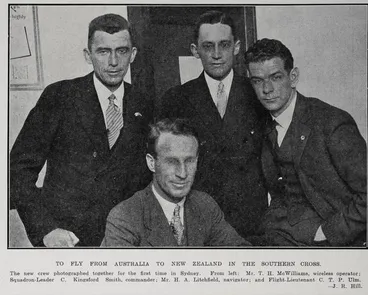
Publicity photo of crew in Sydney: (L-R) Tom McWilliams, Charles Kingsford Smith, Harry Litchfield & Charles Ulm
Tom McWilliams was suggested by NZ Govt as wireless/radio operator & Smith had invited Harry Litchfield as navigator
Auckland Libraries
As a trial run for Litchfield & McWilliams, a non-stop flight was held from Melbourne to Perth on 11-12 Aug 1928
The 'Southern Cross' was piloted by Smith & Ulm, & the flight took 23 ½ hours
National Library of New Zealand
Southern Cross departed from Sydney on Mon 10 Sept 1928 at c.5.34pm (Aust time) & touched down at Christchurch on 11 Sept at 9.22am (NZ time):
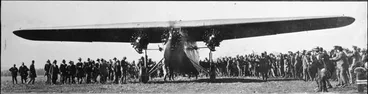
Charles Kingsford Smith's Southern Cross, Wigram, 1928
Auckland Libraries
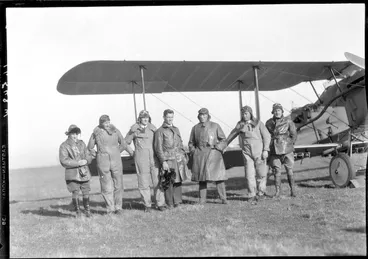
The crew then attended civic receptions in Nth & Sth Islands, travelling by Bristol Fighter planes & cars
Alexander Turnbull Library
The 'Southern Cross' departed from Blenheim on 13 Oct 1928 at c.4:51am & arrived at Sydney on 14 Oct 1928 at 1:42am (Aus time) after 22 hours 51 min flight
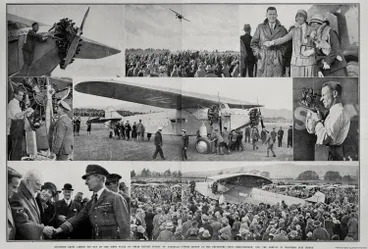
>>>>>>>>>>>>>>>>>>>>>>>>>>>>>>>>>>>>>>>>>>>>>>>>>>>>>>>>>>>>>>>> 2(e) What happened to the Southern Cross?

Flight to England, trans-Atlantic flight to Canada, & revisits to NZ
In Dec 1928, Smith & Ulm registered Australian National Airways (ANA) to provide services in Australia & extend to NZ
They planned to acquire Fokker planes like the 'Southern Cross' to provide passenger, freight & mail services
National Library of New Zealand
On 30 March 1929, 'Southern Cross' left Sydney to fly to England, but weather forced it to land in Western Australia
Smith & Ulm landed on a mudflat & were rescued on 13 April. Southern Cross was repaired & flown back to Sydney.
National Library of New Zealand

On 25 June 1929, 'Southern Cross' flew from Sydney to Croydon, England in record time of 12 days, 14 hours & 18 mins
The crew (Smith, Ulm, Litchfield & Williams) flew via Southeast Asia, the Middle East, & Southern Europe
Auckland Libraries
On 19 July 1929, Southern Cross was flown to Fokker factory in Amsterdam for an overhaul which was completed in May 1930
Meanwhile, the crew visited Netherlands, Germany, France & England, & bought 4 Avro-10 planes for ANA in Sydney
National Library of New Zealand
In Nov 1929, Smith returned by ship to Sydney to plan first flights by ANA for Jan 1930; then went back to Amsterdam
The new Avro 10 planes began flights between Sydney - Brisbane on 1 Jan 1930; then added Sydney - Melbourne on 1 June
National Library of New Zealand

Smith flew 'Southern Cross' to Dublin & departed on 24 June 1930 for first east-west trans-Atlantic flight
3 new crew: Evert van Dijk (co-pilot, Dutch), Paddy Saul (navigator, Irish) & John Stannage (radio operator, NZ)
National Library of New Zealand
They planned to fly to New York & Oakland in California, but landed beforehand in Newfoundland after c.32 hours flying
Due to strong winds & fog, decision was made to land at Harbour Grace in Newfoundland; then fly to NY & on to Oakland
National Library of New Zealand

'Southern Cross' had completed cicumnavigation of the world from Oakland, Califonia to Oakland, Califonia
It had departed from Oakland on 31 May 1928 & flown around globe in stages to arrive back at Oakland on 4 July 1930
Auckland Libraries
On 10 Jan 1931, the 'Southern Cross' was shipped back to Sydney after Smith decided against another trans-Pacific flight
National Library of New Zealand

After Smith & Ulm's ANA had financial issues following plane crashes in March & Nov 1931, only passenger rides kept
The 'Southern Cross' had been deployed to assist during April 1931
Auckland Libraries
In June 1932, at the King's Birthday Honours, Smith received a knighthood for services to Aviation in the Commonwealth
The Evening Post (28 June 1932) also commented that Smith's only income was from 10s joyrides around Australia
National Library of New Zealand
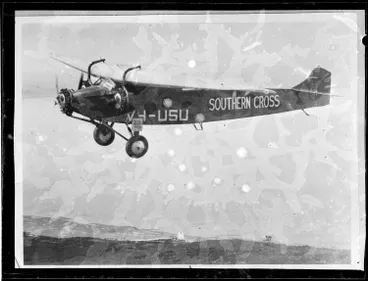
In 1933-34, Smith decided to raise funds for a trans-Tasman mail service & also held joyrides in 'Southern Cross' in NZ
Members of the public could go on sightseeing flights for a fee in Jan-March 1933 & Jan-Feb 1934
Auckland Libraries
Southern Cross sold for preservation as national treaure in 1935
For a chronoloigical acount of the 'Southern Cross' being sold and subsequent locations during World War II and afterwards, see: Adastron: Southern Cross: https://www.adastron.com/southern-cross/default.htm. Currently, it is preserved in a glass hangar memorial on Airport Drive, near the international terminal at Brisbane Airport
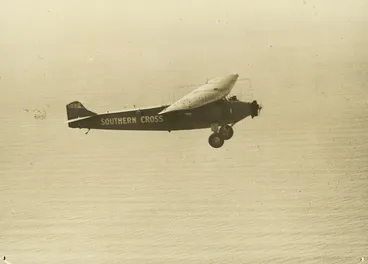
On 18 July 1935, Smith sold 'Southern Cross' for £3000 to Commonwealth of Australia who wanted to nationally preserve it
Smith requested it not flown again & it was placed in storage at RAAF's No. 2 Aircraft Depot in Richmond, Melbourne
Alexander Turnbull Library

During WWII, it was taken from Melbourne to Sydney (see image) & Canberra. It is now on display at Brisbane Airport.
It is preserved in a glass hangar memorial on Airport Drive, near the international terminal at Brisbane Airport
National Library of New Zealand
In 1945, RAAF overhauled 'Southern Cross' for the film "Smithy' about Smith who'd passed away on 8 Nov 1935
Smith & his new plane had disappeared over Andaman Sea near Burma (Myanmar) during flight to England
National Library of New Zealand
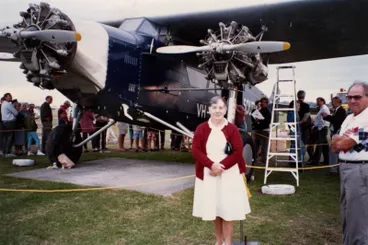
A full-size replica of the 'Southern Cross' was built in Australia and toured NZ in 1989
Later in 2010, HARS Aviation Museum at Shellharbour Regional Airport, NSW acquired the replica from South Australia Govt
Hawke's Bay Knowledge Bank
>>>>>>>>>>>>>>>>>>>>>>>>>>>>>>>>>>>>>>>>>>>>>>>>>>>>>>>>>>>>>>>>>2(f) Commemorations

1928 souvenir
Souvenir of first trans-tasman flight of the 'Southern Cross' 1928
Archives New Zealand Te Rua Mahara o te Kāwanatanga


(Image: 1931) A 1:24 scale model of the 'Southern Cross' created by Austin Byrne & held at National Museum of Australia
Gold and silver plated brass handbuilt model of the Fokker tri-motor monoplane 'Southern Cross', flown by Sir Charles Kingsford-Smith
Trove

(Image: 1932) A plaster bust of Sir Charles Kingsford Smith by Enid Fleming & held at MOTAT
Bust Sir Charles Kingsford-Smith
MOTAT
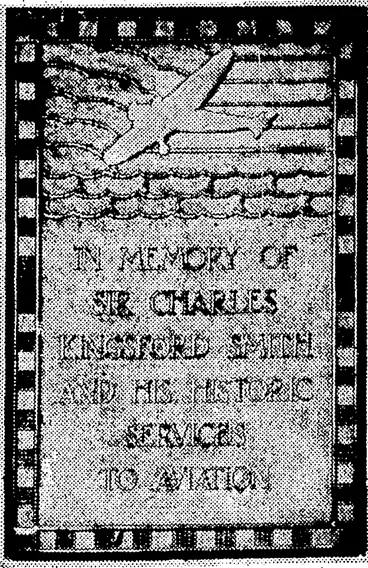
In 1937, plaque presented to the Auckland War Memorial Museum by Sir Ernest Davis, Mayor of Auckland
A uckldnd and Christchurch '■ Tramways teams which yesterday compiled in the Kohn Shield Rugby match. A uckland (left) were the ivinners and play W...
National Library of New Zealand
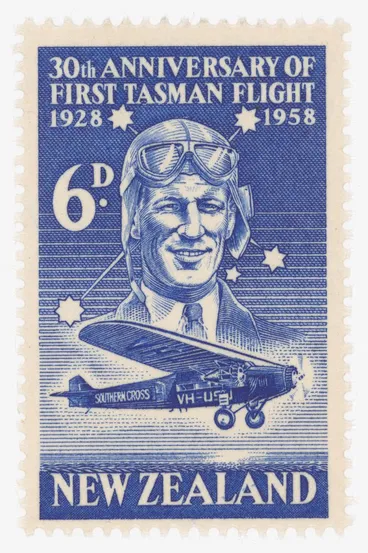
In 1958, six-penny stamp "30th Anniversary of First Tasman Flight 1928" was issued
Issued six penny 'Sir Charles Kingsford-Smith' 30th Anniversary of First Tasman Flight stamp
Museum of New Zealand Te Papa Tongarewa
A 1958 radio documentary recalling the first trans-Tasman flight produced by 1YA, Auckland (29:21 min)
The First Tasman Flight - Kingsford-Smith and the Southern Cross.
Ngā Taonga Sound & Vision

(Image: c.1961) Framed oil on board painting by artist Patrick Hayman & held at MOTAT
Southern Cross 1st Flight to New Zealand from Sydney
MOTAT
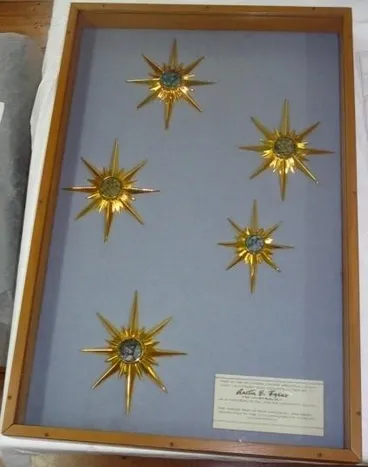
In 1978, MOTAT was presented with ‘Southern Cross Memorial’ made by Australian Austin Byrne
Framed Memorial to Sir Charles Kingsford-Smith
MOTAT
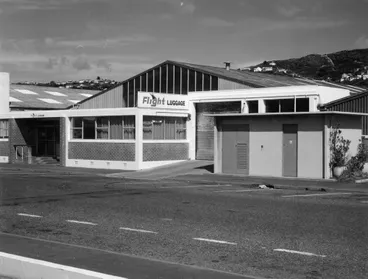
Streets in NZ & the Sydney International Airport were named after Charles Kingsford Smith
Flight Luggage, Kingsford Smith Street, Rongotai
Wellington City Libraries

Aircraft Engine and Propeller J-5A-B Whirlwind and Hamilton Propeller from 'Southern Cross' held at MOTAT
Aircraft Engine and Propeller J-5A-B Whirlwind and Hamilton Propeller from 'Southern Cross'
MOTAT
Find out more:
Adastron: Southern Cross: https://www.adastron.com/southern-cross/default.htm
Brian Lockstone (8 Aug 2018), "The arrival of the Southern Cross at Wigram", Airforce Museum of New Zealand, URL: https://airforcemuseum.co.nz/blog/the-arrival-of-the-southern-cross-at-wigram/
'First trans-Tasman flight touches down', URL: https://nzhistory.govt.nz/the-em-southern-cross-em-completes-the-first-successful-trans-tasman-flight, (Ministry for Culture and Heritage), updated 4 Sep 2020
Jeff Maynard (19 May 2022), "The truth about Kingsfor-Smith's Southern Cross", The Netfield Blog (Netfield Publishing)
Santa Maria Times, Hancock, the aviator, and his School of Aeronautics, (8 Oct, 2017; Updated Jan 15, 2021)
South Australian Aviation Museum: Significant aviator profiles: Sir George Hubert Wilkins
Stephen Sherman, Charles Kingsford Smith: First to Fly Across the Pacific, Ace Pilots, (Oct 2003. Updated April 16, 2012)
Vaughan Yarwood, "The ‘Old Bus’ arrives: Smithy flies the Tasman", New Zealand Geographic (Issue 135, Sept - Oct 2015)
Wings over Cambridge: Sir Charles Kingsford Smith and the crew of the "Southern Cross", URL: https://www.cambridgeairforce.org.nz/Kingsford%20Smith.htm
Wikipedia: Charles Kingsford Smith, URL: https://en.wikipedia.org/wiki/Charles_Kingsford_Smith
Wikipedia: Southern Cross (aircraft), URL: https://en.wikipedia.org/wiki/Southern_Cross_(aircraft)
This DigitalNZ story was compiled in Sept 2023 & updated in Sept 2026